

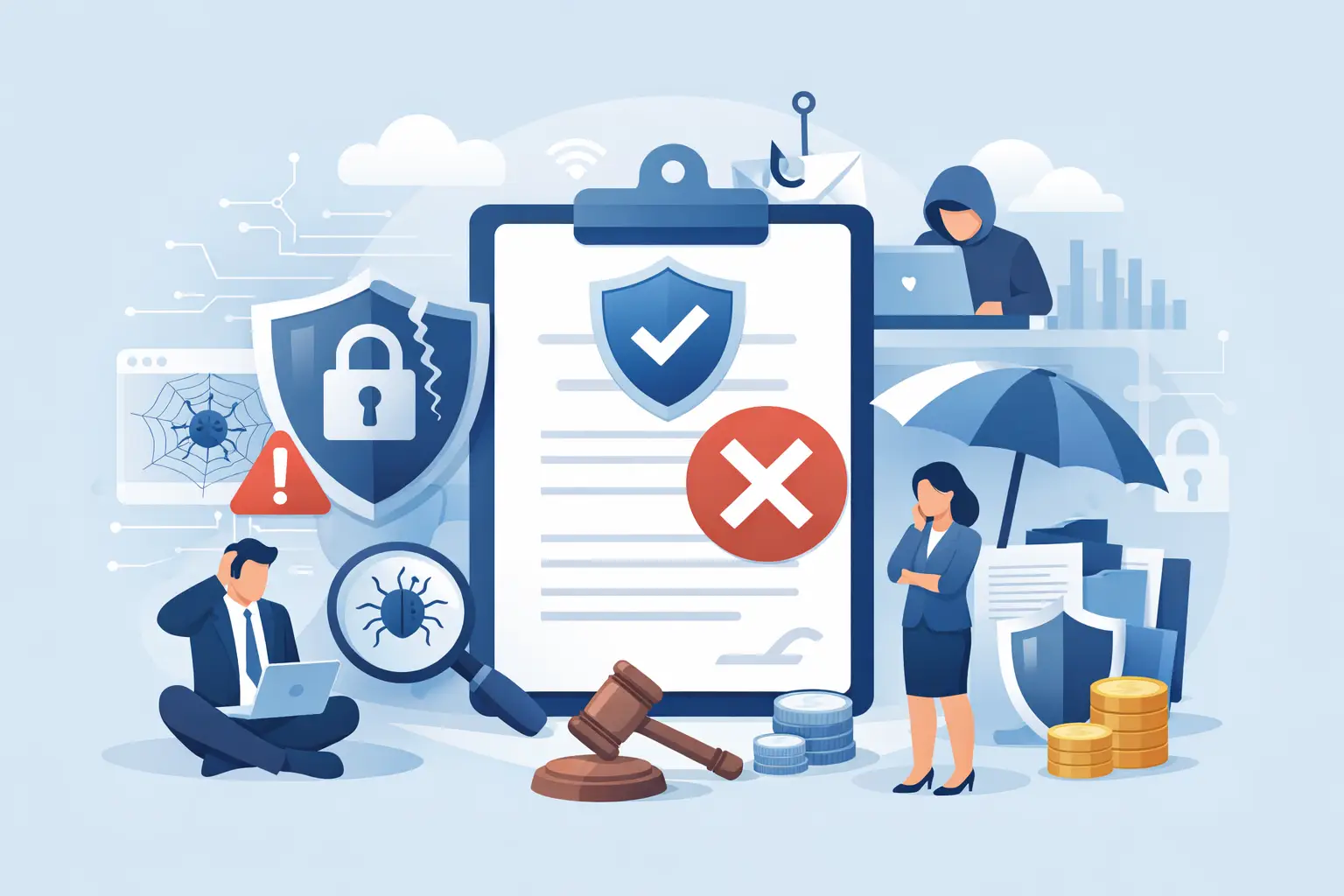
A ransomware note appears on a shared drive at 7.15am. Staff cannot access orders, finance cannot process payments and customers are already calling. At that point, cyber insurance should be part of the recovery plan. So why is cyber insurance denied when a business needs it most? Usually, the answer is not one missing document. It is a gap between what the policy covers, what the business declared during underwriting and what actually happened before or during the incident.
Cyber insurance remains a valuable part of business resilience, but it is not a substitute for managed security, tested recovery processes or clear ownership of IT risk. Understanding the limits before an incident gives decision-makers a far better chance of protecting both their cover and their operations.
Why is cyber insurance denied after an incident?
A declined claim normally comes down to policy terms, inaccurate information, an excluded event or a failure to meet a condition of cover. Insurers assess claims closely because the cost of cyber incidents can rise quickly: forensic investigation, legal advice, customer notification, business interruption, data recovery and extortion demands can all be involved.
The key distinction is between an insurer declining to offer a policy and declining a claim. A business may be refused cover at renewal because its controls are too weak or its risk profile has changed. A claim may be denied because the event falls outside the policy, a requirement was not met, or material facts were not disclosed. Both outcomes are avoidable more often than many organisations realise.
The security controls declared were not in place
Many cyber insurance applications ask direct questions about multi-factor authentication, endpoint protection, backups, patching, privileged access and staff training. These questions are not merely administrative. They form part of the insurer’s assessment of risk and may be reflected in the policy wording.
Problems arise when a business answers based on intention rather than reality. For example, multi-factor authentication may be enabled for Microsoft 365 administrators but not for every user, remote access account or cloud application. Backups may exist, but they may be connected to the network, untested or accessible with the same compromised credentials. A policyholder may believe a control is in place because a tool was purchased, while the insurer assesses whether it was configured, monitored and used effectively.
If the application contains inaccurate or incomplete information, the insurer may argue that it would not have written the policy, or would have applied different terms, had it known the full position. This does not mean every technical imperfection results in a declined claim. It does mean businesses need evidence that key controls are operating as represented.
The incident falls within an exclusion
Cyber policies are contracts, and exclusions matter. Common exclusions can include known incidents that existed before the policy started, deliberate wrongdoing, contractual liabilities that go beyond the insured’s legal liability, and certain failures by third-party providers. The detail varies significantly between policies.
War and state-backed attack exclusions are a high-profile example. Attribution is difficult, and insurers have tightened wording in response to large-scale attacks. Social engineering and invoice fraud can also be misunderstood. Some policies cover fraudulent transfer, but only up to a separate limit or where specific verification procedures were followed. Others require an additional crime or funds-transfer policy.
A standard cyber policy may not pay for every loss connected with a cyber event. Lost future revenue, reputational harm, hardware upgrades or operational improvements may sit outside cover even when the underlying attack is insured. Decision-makers should focus on the precise triggers, sub-limits and exclusions rather than relying on a broad label such as ‘cyber insurance’.
Policy conditions were not followed
Most policies require the insured to notify the insurer promptly, preserve evidence and use approved incident-response suppliers where required. That can feel restrictive during a fast-moving incident, especially when internal teams want to bring in a familiar IT provider immediately. However, insurers need to manage legal exposure, forensic work and the cost of recovery.
Paying a ransomware demand without consent, rebuilding systems before evidence is captured, or appointing advisers outside the insurer’s panel can complicate or reduce a claim. The practical response is not to wait for an incident. Keep the insurer’s notification details, broker contacts and escalation process within the incident-response plan, alongside internal decision-makers and technical contacts.
Poor records make the claim harder to prove
A claim needs a clear account of what happened, when it happened and what losses resulted. Without asset records, security logs, backup reports, supplier contracts and business continuity documentation, it becomes harder to demonstrate the scale and cause of the loss.
Business interruption claims are particularly evidence-heavy. Insurers will look at normal trading patterns, affected systems, downtime, additional costs and the steps taken to reduce disruption. If sales were already declining or an outage would have occurred regardless of the attack, settlement can become more complex. Good operational records are not just a compliance exercise. They support faster recovery and a stronger claim position.
The controls insurers expect to see
There is no universal checklist, because an engineering firm, professional services business and retailer do not carry the same exposure. Yet most insurers now expect a credible baseline of cyber hygiene. The following controls are often central to underwriting and claims discussions:
- Multi-factor authentication for email, remote access, administrator accounts and critical cloud services.
- Managed endpoint detection and response, with active monitoring and a defined escalation route.
- Timely patch management for operating systems, applications, network devices and internet-facing services.
- Segregated, protected backups that are tested regularly against realistic recovery scenarios.
- Least-privilege access, strong password management and rapid removal of leavers’ accounts.
- Security awareness training that addresses phishing, payment fraud and incident reporting.
- A documented incident-response and business continuity plan, tested with technical and business stakeholders.
The value comes from operation, not box-ticking. A multi-factor authentication policy is weak if exceptions are unmanaged. Backups are not reliable if nobody has tested whether critical systems can be restored within an acceptable timeframe. Security tooling creates noise rather than protection if alerts are not monitored and acted upon.
How to reduce the risk of a denied cyber insurance claim
Start by treating the insurance application as a security review. Bring IT, finance, operations and senior leadership into the process. Do not leave it solely to a broker or complete it from memory. Each answer should be verified against current configurations, policies and supplier responsibilities.
Where controls are incomplete, document the gap and establish a realistic remediation plan. It can be better to disclose a limitation and discuss an appropriate policy than to provide an answer that cannot be supported later. Transparency may affect premium, excess or available cover, but it avoids creating a more serious dispute after an incident.
Next, read the policy schedule and wording with a focus on business impact. Confirm the limits for incident response, data restoration, business interruption, cyber extortion, privacy liability and funds transfer. Check waiting periods, definitions of a network interruption, territorial limits and obligations involving outsourced IT or cloud providers. A low premium can become expensive if the cover does not match the way your business operates.
Then build the insurance process into the wider incident plan. Define who can notify the insurer, who can authorise external spend, who communicates with customers and regulators, and how decisions will be recorded. Run a tabletop exercise around a ransomware event or compromised email account. These exercises expose uncertainty before it becomes downtime.
For businesses without internal security capacity, a managed IT and cybersecurity partner can provide the ongoing visibility that applications and claims demand. WestTech helps organisations bring security controls, infrastructure management, compliance support and practical incident preparation under one accountable service model. The objective is straightforward: fewer unmanaged gaps, clearer evidence and faster action when pressure is highest.
Insurance supports recovery. It does not replace readiness.
Cyber insurance can help absorb financial shock, access specialist response support and protect continuity after a serious attack. It cannot compensate for weak access controls, untested backups or uncertainty over who owns the response. The strongest position is a policy that reflects your real environment, supported by security controls that work every day and records that prove it.
Before your next renewal, test the assumptions behind the application. The question is not simply whether you have cyber insurance. It is whether your business can show, under pressure, that the protection you said you had is genuinely in place.