
A security alert at 02:00 is only useful if someone can assess it, contain the threat and tell the business what happened. That is the practical issue behind SIEM vs MDR explained. Both can improve cyber visibility, but they solve different operational problems. Choosing the wrong model can leave an IT team paying for data they cannot act on, or outsourcing response without enough control over the environment.
For most organisations, the decision is not about buying more security technology. It is about deciding who is responsible for turning security signals into decisive action when systems, customers and operations are at risk.
SIEM vs MDR explained: the core difference
A Security Information and Event Management platform, or SIEM, collects and analyses security logs from across an IT environment. These can include firewalls, servers, cloud services, endpoints, identity platforms, email systems and business applications. It centralises events, correlates suspicious activity and presents alerts or reports to the people responsible for security.
Managed Detection and Response, or MDR, is a service. A specialist security team monitors an organisation’s environment, investigates suspicious activity and responds to confirmed threats. MDR normally combines security tools, threat intelligence, analysts and defined response processes into one managed service.
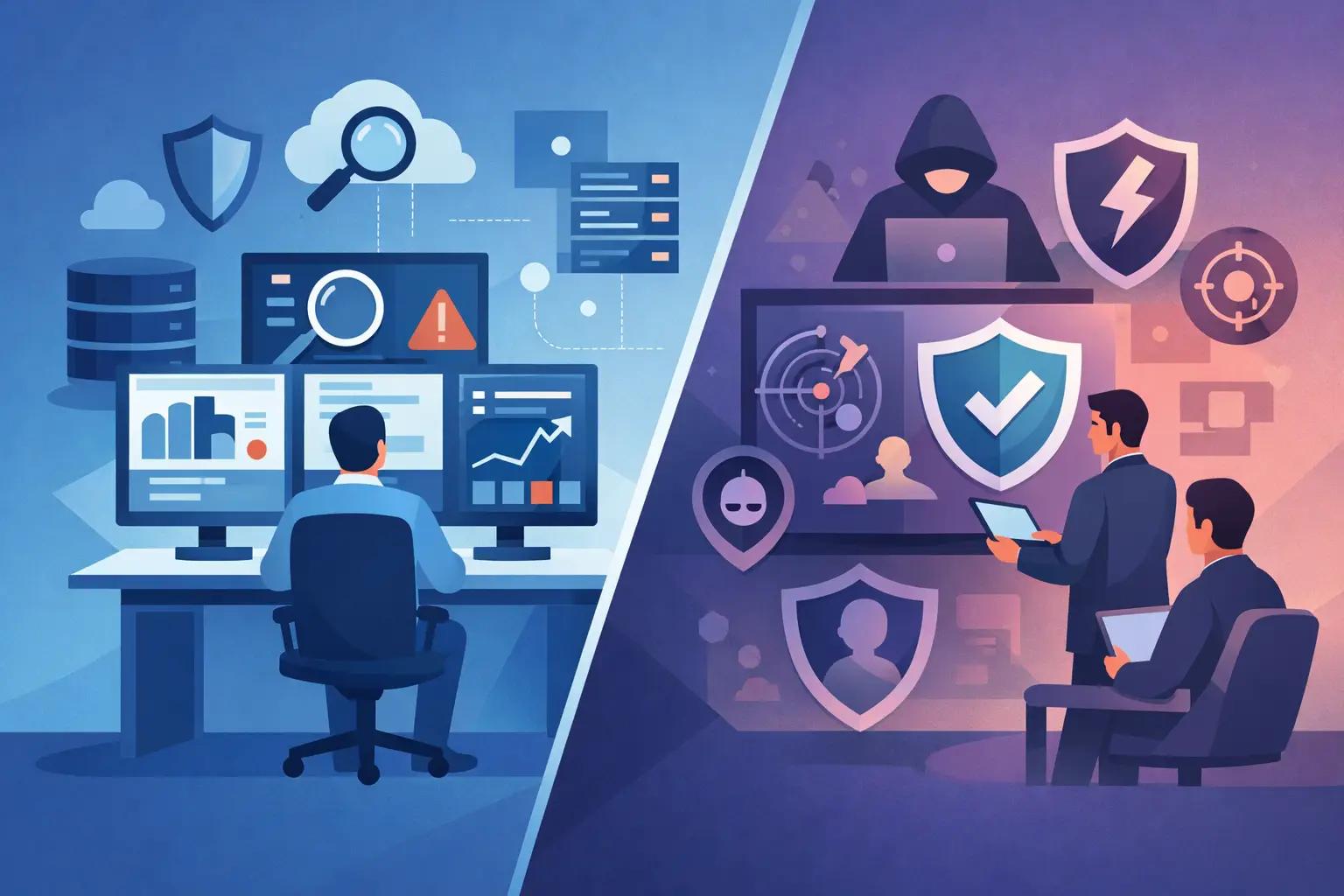
Put simply, a SIEM is primarily a visibility and analytics platform. MDR is an ongoing detection and response capability. A SIEM can form part of an MDR service, but owning a SIEM does not automatically mean the business has 24/7 monitoring or incident response.
That distinction matters when an attacker uses valid credentials, moves between systems or attempts to encrypt critical files outside office hours. The technology may identify unusual behaviour. The real question is whether a skilled person is available to investigate quickly and take the next step.
What a SIEM does well
SIEM is particularly valuable for organisations that need a central record of security events. It can bring order to a complex environment where data is spread across on-premises infrastructure, cloud platforms, remote devices and multiple business locations.
Its strongest benefits are visibility, reporting and investigation. Security and IT teams can search historical activity, identify patterns across systems and retain audit evidence. This can support compliance requirements where organisations need to demonstrate that access, changes and security events are monitored.
For a business with an established internal security function, SIEM can be an effective foundation. Analysts can tune detection rules, investigate alerts and use the data to improve controls over time. Larger organisations may also need the flexibility to integrate specialist applications, operational technology or custom workflows.
However, SIEM is not a set-and-forget product. It needs careful implementation, log-source management, data retention planning and ongoing tuning. Poorly configured rules create noise. Missing log sources create blind spots. Excessive data ingestion can also make costs difficult to predict.
A SIEM deployment works best when there is clear ownership. Someone must decide which events matter, review alerts, maintain use cases and turn findings into improvements. Without that operating model, a SIEM can become an expensive archive of alerts rather than a meaningful security control.
Where MDR changes the equation
MDR is designed for businesses that need active security coverage but do not want to build and staff a security operations centre internally. The provider supplies the people and process as well as the technology needed to detect and respond.
A typical MDR service monitors endpoint, identity, network and cloud signals around the clock. When suspicious behaviour is detected, analysts investigate it in context. They distinguish a genuine threat from ordinary business activity, then follow agreed procedures to contain or remediate the risk.
That may involve isolating a compromised device, disabling an account, blocking malicious activity or escalating directly to the customer’s IT contact. The precise actions depend on the service agreement and the level of access granted to the provider. Clear escalation paths are essential. Speed is valuable, but so is knowing who can authorise disruptive action in a production environment.
MDR reduces the burden on internal teams that are already managing users, infrastructure, suppliers and day-to-day support. Rather than asking an IT manager to interpret hundreds of alerts, it provides a prioritised view of incidents that require business attention.
The trade-off is that the quality of the outcome depends on the provider’s coverage, expertise and response commitments. Not all MDR services monitor the same tools, investigate to the same depth or have the same authority to contain threats. Businesses should look beyond the label and understand exactly what is monitored, what happens after an alert and how quickly the service engages.
Which model suits your business?
The right answer depends less on company size than on internal capability, risk profile and operational requirements.
A SIEM may be the better fit if your organisation has dedicated security analysts, mature incident response procedures and a clear need for detailed log retention and custom reporting. It gives internal teams significant control and can support complex compliance obligations. The investment is not limited to licensing, however. Budget must also cover implementation, engineering, monitoring and continual improvement.
MDR is often the stronger option for SMB and mid-market businesses that need better protection now, but do not have a 24/7 security team. It offers a clearer path to continuous monitoring, expert investigation and defined response without recruiting specialists for every shift.
For many organisations, the best approach is a combination. An MDR provider may use SIEM capabilities to collect and correlate security data, while its analysts provide the monitoring and response layer. This can give the business both evidence for governance and practical support during an incident.
The key is to avoid buying a tool because it appears on a compliance checklist. Start with the business outcome: reduced time to detect threats, reduced time to contain them, and clear accountability when something goes wrong.
Questions to ask before choosing SIEM or MDR
Before committing to either model, assess your current environment honestly. How quickly would your team notice a compromised Microsoft 365 account or unusual administrator activity? Who investigates an alert overnight? Can they isolate a device without waiting for a third party? Are logs retained in a way that supports insurance, regulatory or forensic requirements?
Then assess the service or platform in operational terms. Ask which systems are covered, whether cloud and identity activity are included, how alerts are triaged and what response actions are available. Establish who owns configuration, rule tuning and regular reporting. If an incident occurs, identify the named contacts, escalation times and decision-making process before the pressure starts.
Commercial clarity matters too. SIEM pricing can rise with data volumes, while MDR costs may vary by endpoint, user or service scope. A lower monthly figure is not necessarily better value if it excludes critical systems, limits response activity or leaves internal staff carrying the difficult work.
Build security around accountability
A successful security model should fit the way your business operates, not force your people into an unrealistic process. If internal teams need deep data control and have the capacity to run it, SIEM can provide valuable visibility. If the priority is active protection and faster expert response, MDR may offer a more practical route.
WestTech helps businesses assess security risk in the context of their wider IT estate, from devices and cloud services to network infrastructure and operational continuity. The objective is straightforward: establish clear coverage, clear responsibilities and support that acts when it matters.
The most useful next step is not to compare acronyms in isolation. Map a realistic incident from first alert to recovery, identify every hand-off, and make sure someone is accountable at each point. That is where security investment starts protecting the business rather than simply adding another dashboard.