
A meeting room that will not connect, access control that works on one floor but not another, screens showing the wrong content, patchy Wi-Fi, and five suppliers all blaming each other – that is usually where smart office technology integration starts. The idea is straightforward. The delivery rarely is. For businesses investing in modern workplaces, smart office technology integration is less about adding gadgets and more about making systems work together reliably, securely and with clear ownership.
What smart office technology integration actually means
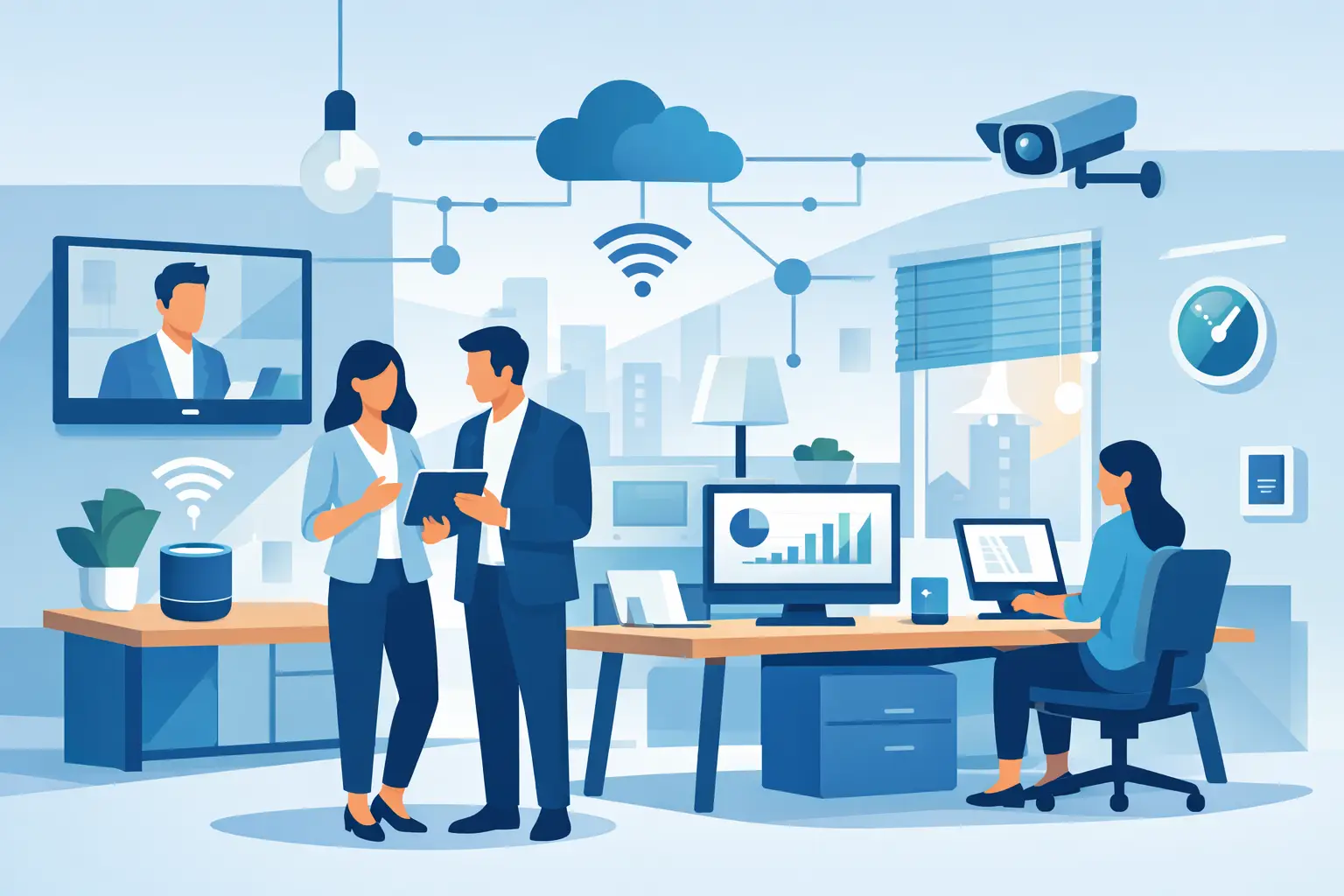
A smart office is not defined by motion sensors or a booking tablet outside a boardroom. It is defined by how well connected systems support day-to-day operations. That can include network infrastructure, wireless coverage, meeting room AV, digital signage, access control, environmental monitoring, occupancy data, printing, endpoint devices and cloud-based management tools.
The integration piece matters because these systems do not operate in isolation. A visitor management platform may need to work with door access. Room booking may need to connect with calendar systems and display panels. Digital signage may rely on the same network policies as other business-critical devices. Facilities teams may need building alerts, while IT teams need visibility, patching and support.
When these elements are deployed separately, businesses often end up with inconsistent standards, duplicated costs and avoidable support issues. When they are integrated properly, the office becomes easier to run and far less frustrating to use.
Why businesses get smart office projects wrong
Most office technology problems are not caused by ambitious plans. They are caused by fragmented delivery.
One provider installs AV. Another handles structured cabling. A third supplies access systems. Internal IT is expected to make everything work together while also managing users, cyber risk and business continuity. The result is familiar: delays, unclear responsibilities, poor documentation and systems that technically function but create daily friction.
This is where trade-offs start to matter. The lowest upfront quote can lead to the highest ongoing support cost. A platform with dozens of features may add complexity your team will never use. A quick install without proper testing may save time in the short term but create months of call-outs and lost productivity.
For most businesses, the better question is not, “How smart can the office be?” It is, “How well will this environment perform six months after go-live?”
Smart office technology integration needs an operational plan
Technology decisions in offices are often treated as fit-out decisions. In practice, they are operational decisions.
If your wireless design does not account for dense meeting areas, hot-desking and signage traffic, user experience suffers. If meeting room devices are easy to deploy but hard to support remotely, your IT team inherits an unnecessary burden. If access control data sits in a separate silo from wider security monitoring, response times slow down when issues occur.
A workable plan starts with business use. Who needs the office to do what? How many users are on site each day? Which systems are business-critical? What level of resilience is needed? What happens if one platform goes offline? These questions sound basic, but skipping them is one of the fastest ways to overspend on technology that does not fit the environment.
Start with the core systems
The strongest smart office projects are built on reliable foundations. That means structured cabling, switching, power, wireless, internet resilience, endpoint management and security controls come before the more visible tools.
There is little value in installing premium room booking panels if the network underneath is inconsistent. The same applies to digital signage or sensor-based automation. If the core infrastructure is weak, the smart layer becomes another source of faults rather than an operational improvement.
Design for support, not just deployment
An office may look finished on handover day and still be poorly integrated. The real test comes later – when devices need firmware updates, users change, floorplans shift, or a platform vendor changes requirements.
Supportability should be built in from the start. That includes standardised hardware, remote monitoring, documented network policies, sensible admin access, asset visibility and a clear escalation path. If your team cannot quickly identify what is connected, who owns it and how it is maintained, the office will become harder to manage over time.
Security cannot be bolted on afterwards
Smart offices expand the number of connected devices inside the business. Every display, controller, sensor, access point and room system increases the number of things that need to be managed and protected.
That does not mean smart office technology integration is inherently risky. It means it has to be approached with the same discipline as any other business IT environment. Device segmentation, identity controls, patch management, secure remote access, logging and vendor risk reviews should be part of the deployment plan, not an afterthought.
There is also a compliance angle. For organisations handling sensitive data, visitor systems, surveillance tools and occupancy platforms can introduce privacy considerations that cross over between IT, HR, facilities and leadership. If nobody owns that conversation early, it tends to surface later in the form of delays or rework.
This is one reason a single accountable partner can make such a difference. Security, infrastructure and implementation decisions affect each other. Treating them as separate workstreams often creates gaps.
Where businesses usually see the biggest return
The strongest returns from smart office projects are rarely the most visible ones. Impressive screens and automated controls have their place, but the long-term value usually comes from reducing friction.
Meeting spaces become easier to use. Staff spend less time working around avoidable tech issues. Facilities and IT teams gain better visibility. Office moves and layout changes are less disruptive. Power usage and space usage become easier to measure. Support becomes more predictable because systems are standardised rather than assembled from one-off decisions.
That return depends on the environment. A professional services firm may care most about reliable hybrid meeting rooms and secure guest access. A retailer may prioritise signage management, connectivity and rapid support across sites. A growing business moving into a new office may need a platform that scales without replacing everything in two years.
That is why the right design is context-specific. There is no universal smart office stack that suits every business.
Choosing the right partner for smart office technology integration
If a project touches IT, AV, electrical infrastructure, access systems and support, hand-offs become a risk. Every additional supplier increases the chance of delay, inconsistency and blame-shifting.
A better model is joined-up delivery with one team accountable for design, implementation and ongoing support. That does not just simplify procurement. It improves decision-making during the project. Network design can reflect signage demands. Security controls can be aligned with access systems. Meeting room standards can be set with actual support capacity in mind.
For businesses that do not want to manage multiple vendors, this is usually the difference between a clean rollout and a prolonged snagging period.
WestTech’s approach is built around that one-partner model. The value is practical: fewer gaps between disciplines, clearer ownership and a smarter office environment that remains manageable after installation.
Questions to ask before you invest
Before approving a project, it is worth pressure-testing a few assumptions. Are you solving a real operational problem or just adding features? Can the environment be supported without depending on one person internally? Will the system still work as your headcount, floorplan or security needs change? Do you know how incidents will be handled when multiple systems overlap?
You should also ask what success looks like after launch. Faster room turnarounds? Less downtime? Better visibility for facilities? Simpler support? If the answer is vague, the specification probably needs more work.
Smart office technology integration is only worthwhile if it reduces complexity
The best office technology does not demand attention. It helps people get through the day with fewer interruptions, fewer workarounds and fewer support tickets. That requires more than product selection. It requires joined-up planning, solid infrastructure, clear security controls and ownership that does not disappear once the fit-out is complete.
If your office systems are making work harder rather than easier, the issue is not that the office is not smart enough. It is that the technology has not been integrated with enough discipline. Get that part right, and the office becomes simpler to run, easier to scale and far more dependable when the business needs it most.