
A boardroom that looks impressive on day one but fails under pressure by week three is not an upgrade. It is another operational problem. That is why office audio visual installation needs to be treated as part of the wider business environment, not as a standalone fit-out item. If the room audio is poor, the display placement is wrong, or the network cannot support the system properly, your teams feel it immediately in missed time, poor meetings and avoidable support calls.
For most businesses, the real cost of AV is not the screen or camera. It is the friction. Meetings start late because no one can connect. Hybrid calls lose momentum because remote participants cannot hear clearly. Reception signage goes dark because the system was installed without proper power, management or support. None of that is a technology issue in isolation. It is a delivery and ownership issue.
What good office audio visual installation actually looks like
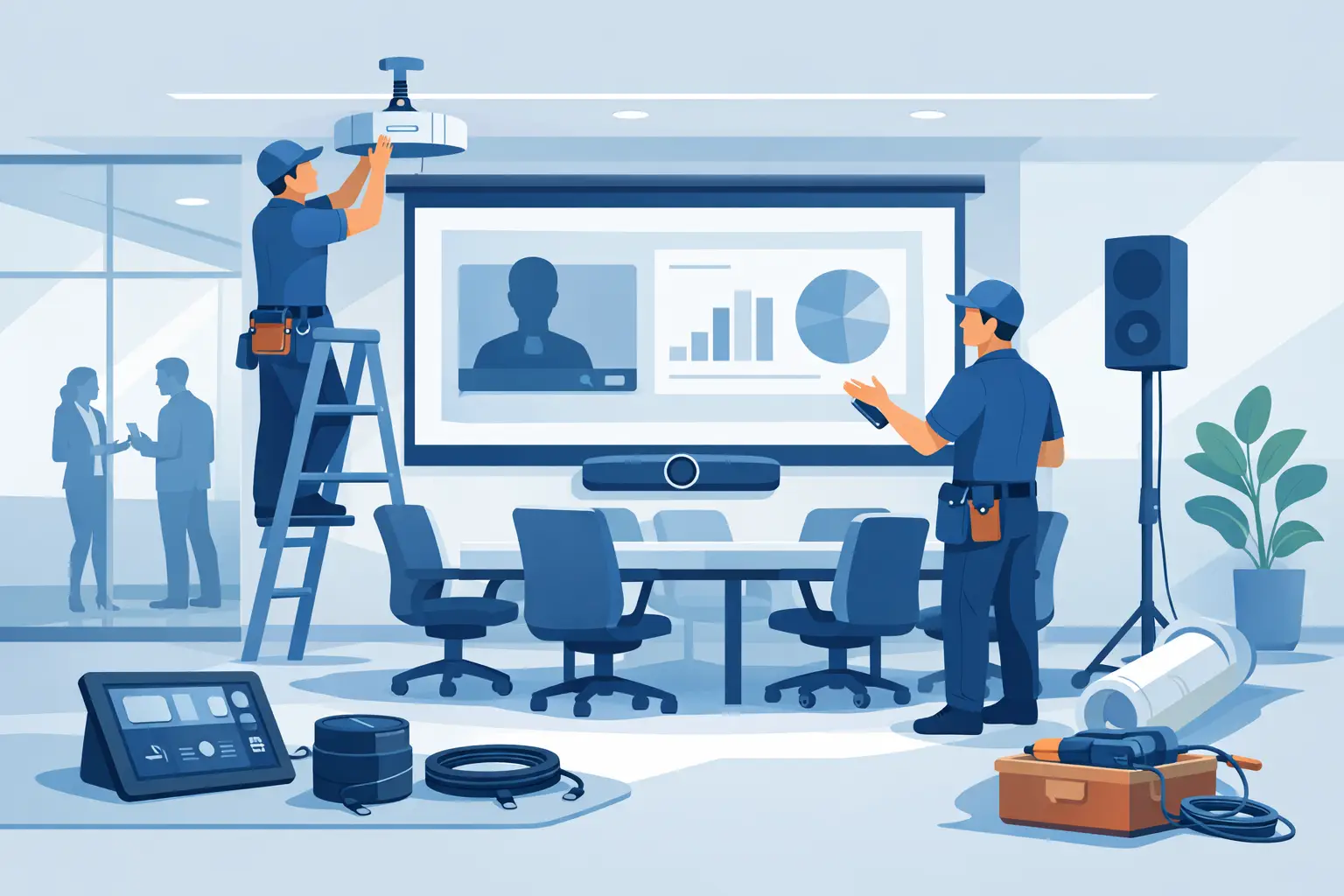
A good installation starts with the way the space is used. A small huddle room has different needs from a client-facing boardroom, a training room or an open-plan collaboration area. The right design considers room size, acoustics, lighting, sightlines, power, cabling, network access, wall construction and how staff will actually use the equipment day to day.
That sounds obvious, but many AV projects still go wrong because the buying decision is led by product choice before the environment has been assessed. A premium camera in a badly lit room will still produce poor results. A large display installed at the wrong height will still create viewing issues. Ceiling microphones can perform well, but not in every room and not with every ceiling type. There is no single best setup. It depends on the space, the users and the operational standards you need to maintain.
The strongest projects also account for support from the start. If your meeting room technology depends on three separate providers for hardware, cabling and network troubleshooting, faults take longer to resolve and accountability becomes blurred. When AV is tied into your wider IT and facilities environment, it is easier to manage, easier to secure and easier to scale.
Why AV projects fail in otherwise well-run offices
The common failure points are rarely dramatic. They tend to be small decisions made too late or by the wrong people. Cabling routes are not planned early enough, so visible trunking becomes the compromise. Audio coverage is assumed rather than tested, so voices drop out in larger rooms. Displays are selected before checking wall strength, power position or glare from windows. Control systems are installed without thinking about who will support them six months later.
There is also the issue of vendor sprawl. One supplier handles the screens, another installs the wiring, a third manages the network and someone else is expected to fix faults when users start complaining. On paper, that can look cost-effective. In practice, it often creates delays, finger-pointing and higher support overhead.
Security is another blind spot. Modern AV systems sit on the network, use cloud-based management, and often include cameras, microphones and wireless sharing tools. If they are deployed without the same discipline applied to the rest of your IT estate, they introduce unnecessary risk. That matters more in regulated businesses, but it matters in every office.
Office audio visual installation is now an infrastructure decision
Five years ago, many businesses treated AV as a finishing touch. Now it has a direct effect on productivity, client experience and workspace strategy. Hybrid working changed expectations permanently. Staff expect meeting rooms to work first time. Leadership teams expect better communication across sites. Front-of-house areas increasingly rely on digital signage for messaging, branding and visitor flow.
That changes the brief. Office audio visual installation is no longer just about putting equipment into rooms. It is about making those rooms usable, reliable and consistent across the business. It also means AV should be planned alongside connectivity, cybersecurity, electrical work and room design, not after those decisions have already been made.
This is where a joined-up delivery model makes a difference. If the same partner can assess the room, manage the cabling and power, align the installation with your network standards, and provide ongoing support afterwards, projects move faster and issues are easier to resolve. The value is not just technical. It is operational.
Planning an installation around business outcomes
The right first question is not, “Which screen should we buy?” It is, “What does this room need to do reliably?” A boardroom may need strong camera framing, clean voice pickup and simple one-touch meeting access for senior stakeholders and clients. A training space may need flexible display layouts, better presenter control and audio coverage across the room. A reception area may need bright, centrally managed signage with resilient power and content scheduling.
Once those use cases are clear, the design becomes far more practical. You can decide whether a room needs a single display or dual screens, whether wireless presentation is worth the added complexity, whether integrated room booking is useful, and how much control should be exposed to users versus locked down for consistency.
There are trade-offs. Simpler systems usually generate fewer support issues. More advanced setups can improve the experience, but only if the users are comfortable with them and the support model is ready. Cost matters, but so does downtime. The cheapest installation is not the best value if it leads to constant faults, poor adoption or rework.
The role of support after the install
This is the point many suppliers underplay. Installation is only one phase. Once the room is live, the business still needs updates, troubleshooting, device management and a clear route for support. If a camera firmware issue affects compatibility with your meeting platform, someone needs to pick that up early. If signage players lose connection or displays fail, the response needs to be quick and accountable.
For IT and operations leaders, that ongoing support model is often the deciding factor. Internal teams do not want another isolated system to manage. They want standardisation, visibility and fast resolution when something stops working. That is especially true across multiple rooms or sites, where small inconsistencies become a larger support burden.
A dependable partner will design with maintenance in mind. That means sensible equipment choices, clean documentation, labelled infrastructure, remote management where appropriate, and a support structure that does not disappear after handover. WestTech’s approach is built around that principle – design, deployment and ongoing ownership should sit together, not be split across disconnected suppliers.
What to look for in an AV partner
If you are comparing providers, look beyond the equipment list. Ask how they assess room suitability, how they coordinate with IT and electrical requirements, what support looks like after installation, and who takes responsibility when multiple systems intersect. A polished proposal is useful, but operational clarity is better.
You should also expect realistic advice. Not every room needs the highest-spec package. Not every space benefits from added control layers or premium audio design. A good partner will tell you where to invest and where to keep things simple. They will also flag constraints early, whether that is wall structure, acoustics, power availability or network readiness.
For growing businesses, scalability matters as well. An isolated room build might solve one short-term need, but if your office estate is expanding, consistency becomes more valuable. Standard platforms, repeatable room designs and central support reduce long-term complexity and cost.
Getting the office audio visual installation right first time
The strongest installations feel unremarkable in use. Meetings start on time. Participants can see and hear properly. Content displays clearly. The room works the same way each day, with minimal user effort and minimal support intervention. That is what success looks like.
Getting there takes more than product selection. It takes proper scoping, joined-up delivery and accountability after the room goes live. For decision-makers balancing budget, user experience and operational risk, that is the difference between another technology headache and a workspace that actually supports the business.
If you are planning a new fit-out, refurbishing meeting rooms or standardising AV across multiple spaces, treat the project as part of your wider infrastructure. When AV, IT, power and support are aligned from the start, the result is simpler to manage and far more reliable where it counts – in daily use.