
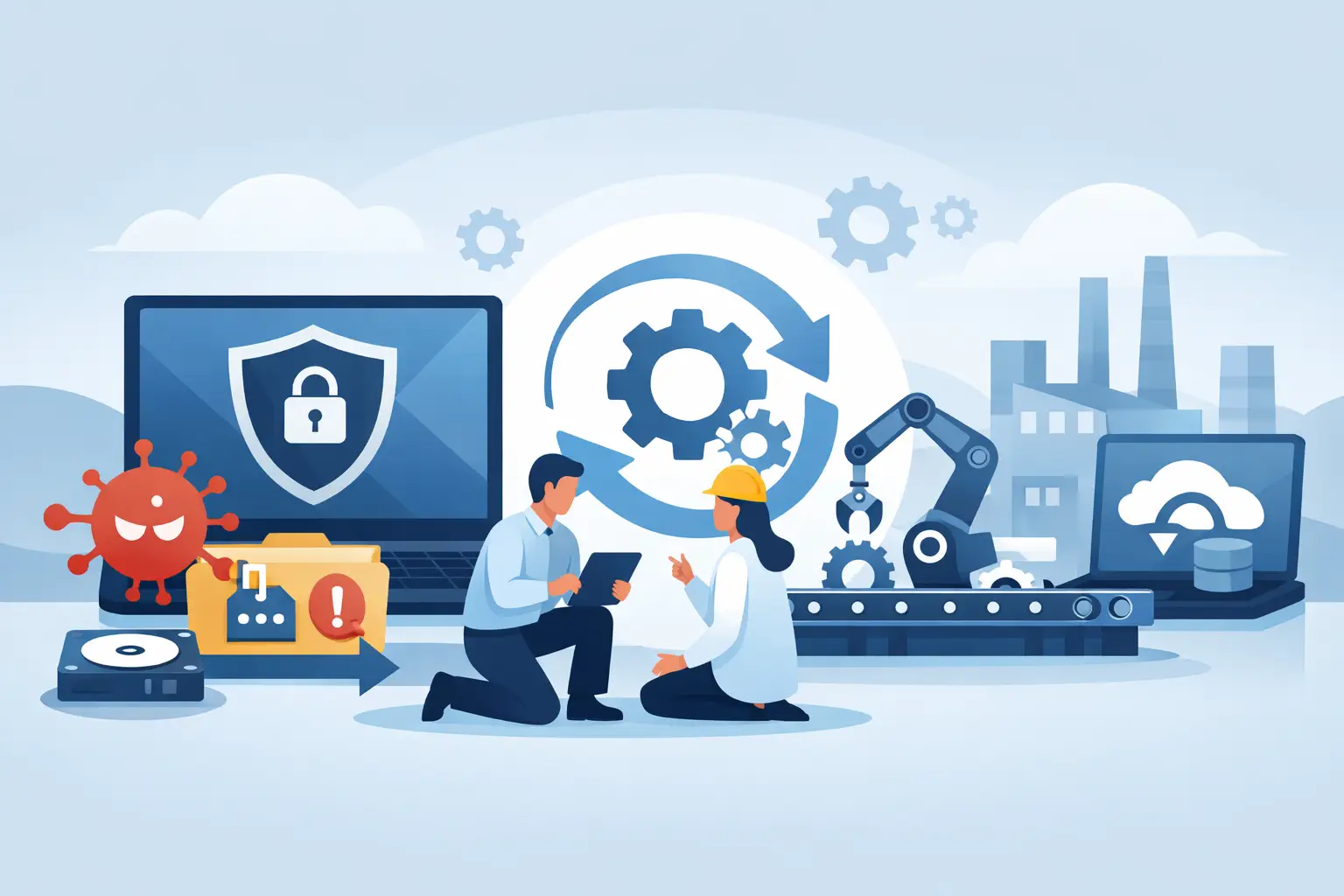
At 06:40, the first shift arrives and the label printers are down. By 07:05, the ERP screen is frozen. By 07:20, supervisors are using paper to track raw materials because production scheduling has stopped updating. This ransomware recovery for manufacturing example is not about theory. It is about what happens when an attack hits a live plant where every hour of downtime affects output, customer commitments, and cash flow.
Manufacturing businesses face a harder version of ransomware recovery than most office-based organisations. They are not only restoring files and user access. They are protecting production lines, quality systems, warehouse operations, supplier communications, and in many cases ageing operational technology that was never designed for modern cyber threats. The recovery plan has to work in the real world, under time pressure, with safety and commercial impact both on the line.
A ransomware recovery for manufacturing example
Imagine a mid-sized food packaging manufacturer with one main site, 180 staff, and a mix of IT and OT systems. The company runs an ERP platform for orders and stock, a manufacturing execution system for production planning, networked HMIs on the line, CCTV, remote vendor access for machinery support, and a small internal IT team supported by an external technology partner.
The attack begins with a compromised user account. An employee in finance opens what appears to be a supplier document. The attacker gains a foothold, escalates privileges, and moves laterally over a weekend. By Monday morning, file servers are encrypted, several Windows endpoints are unusable, and parts of the virtual environment are affected. The attackers also attempt to reach systems connected to production.
What matters next is not panic or guesswork. It is whether the business has a clear sequence for containment, prioritisation, restoration, and communication.
First priority: contain the spread
The first stage of recovery is not restoring backups. It is stopping the situation getting worse. In manufacturing, that often means making a fast distinction between systems needed for safe plant operation and systems already compromised.
The response team isolates infected servers, disables affected accounts, and removes remote access pathways. Segmentation between IT and OT becomes critical here. If the plant network is well segmented, some lines may continue operating in a controlled mode while business systems are contained. If segmentation is poor, the business may have no safe option except to halt operations more broadly.
This is one of the biggest trade-offs in any ransomware recovery for manufacturing example. A full shutdown can increase short-term losses, but trying to keep too much running without visibility can turn a contained incident into a site-wide outage. Safety, not optimism, should decide that call.
Second priority: establish what still works
Manufacturers rarely fail in a neat, all-or-nothing way. Some assets remain usable. Others are unavailable but recoverable. A few may be untrusted and need full rebuilds.
The incident team maps systems into three groups. First are critical operational services such as domain services, clean backup infrastructure, core networking, and plant systems required for safe operation. Second are commercially urgent systems such as ERP, warehouse management, order processing, and customer communications. Third are lower-priority platforms that can wait.
This triage matters because the business does not need everything back at once. It needs the right things back in the right order. A manufacturer can often tolerate temporary workarounds for finance or HR longer than it can tolerate loss of stock accuracy, dispatch visibility, or recipe and batch traceability.
What good recovery looks like in manufacturing
In our example, the manufacturer had immutable backups for core servers, documented recovery priorities, and network segmentation between office IT and the most sensitive production systems. That did not make the incident easy. It made recovery possible.
By late morning on day one, the company confirms backup integrity from a clean environment. It also confirms that a small number of OT-adjacent engineering workstations are at risk, which means vendor access is suspended until those devices are assessed and rebuilt.
By the end of day one, temporary business continuity measures are in place. Production planning is moved to controlled manual scheduling. Goods-in and goods-out are tracked on paper with defined checkpoints. Customer service is given a script for delivery queries. Senior management receives a clear operational status update rather than a technical data dump.
That kind of response is often the difference between difficult disruption and prolonged chaos. Staff do not need every technical detail. They need to know what changed, what process to follow, and who owns the next decision.
Restoring core services without reintroducing risk
Recovery on day two focuses on identity, core virtual infrastructure, and the minimum viable systems needed to support production and dispatch. Clean domain controllers are restored first. Then the team restores file services required for controlled operations, followed by ERP components in a segregated recovery environment.
This stage is slower than many business leaders expect, and for good reason. Restoring quickly is not the same as restoring safely. If compromised credentials, persistence mechanisms, or infected endpoints are brought back into the environment, the business can end up paying for the same outage twice.
For manufacturers, this is where external coordination matters. Internal IT may understand the estate, but recovery often also requires cyber incident handlers, backup specialists, infrastructure engineers, legal advisers, insurers, and machinery vendors. A fragmented approach wastes time. One accountable partner who can coordinate technical recovery and operational communication reduces delay and confusion.
OT recovery needs a different mindset
Office systems can usually be rebuilt to a standard pattern. Production environments are less forgiving. HMIs, SCADA elements, PLC-connected workstations, and specialist industrial software often depend on older operating systems, bespoke configurations, or supplier-controlled access.
That means OT recovery should not be treated as a standard desktop exercise. Every change needs to consider plant safety, production tolerances, and vendor requirements. In some cases, the safest route is to isolate OT from affected IT systems and keep lines in a reduced-capacity mode until forensic confidence improves. In others, a controlled shutdown is the only sensible option.
There is no universal answer here. It depends on the maturity of segmentation, the age of the equipment, and whether the manufacturer has current asset documentation. Businesses with poor visibility often lose crucial hours simply identifying what is connected to what.
Lessons from this ransomware recovery for manufacturing example
The most useful lesson is simple. Recovery starts long before the attack. The manufacturer in this example did not avoid disruption, but it avoided a far worse outcome because the foundations were in place.
Backups were tested rather than assumed. Recovery priorities reflected production reality rather than IT preference. Access paths were limited. Key contacts were documented. Manual fallback processes existed, even if they were not elegant. Those basics are not glamorous, but they keep businesses moving when systems fail.
Just as important is the commercial lens. Manufacturing ransomware is not only a cyber issue. It is a delivery issue, a customer service issue, a compliance issue, and potentially a safety issue. Leaders should assess recovery plans against practical questions. Can you still receive raw materials? Can you trace batches? Can you dispatch finished goods accurately? Can you prove what happened for insurers, customers, or regulators? If the answer is unclear, the recovery plan is not finished.
What decision-makers should review now
If you are responsible for IT, operations, or site continuity, the right question is not whether ransomware is possible. It is whether your business could recover without guesswork.
Start with backup architecture and recovery testing. Then review segmentation between office IT and production networks. Check remote access controls, especially for third parties. Confirm that recovery priorities reflect revenue, production, and compliance dependencies. Finally, make sure your incident process includes communications for staff, customers, suppliers, and insurers.
For many manufacturers, the biggest weakness is not a missing tool. It is split accountability. Cybersecurity sits with one supplier, infrastructure with another, backup with a third, and plant technology somewhere else again. When an incident happens, that model breaks down quickly. A single technology partner with visibility across infrastructure, security, and operational support can shorten recovery time simply by removing coordination delays.
WestTech works with businesses that need that joined-up model because downtime is rarely caused by one isolated failure. It is usually the result of gaps between systems, teams, and responsibilities.
Ransomware recovery in manufacturing is never tidy. The best outcome is not perfection. It is controlled recovery, clear decisions, and a business that can keep serving customers while the technical work is done properly. If your current plan relies on assumptions, now is the time to replace them with tested processes you can trust under pressure.