

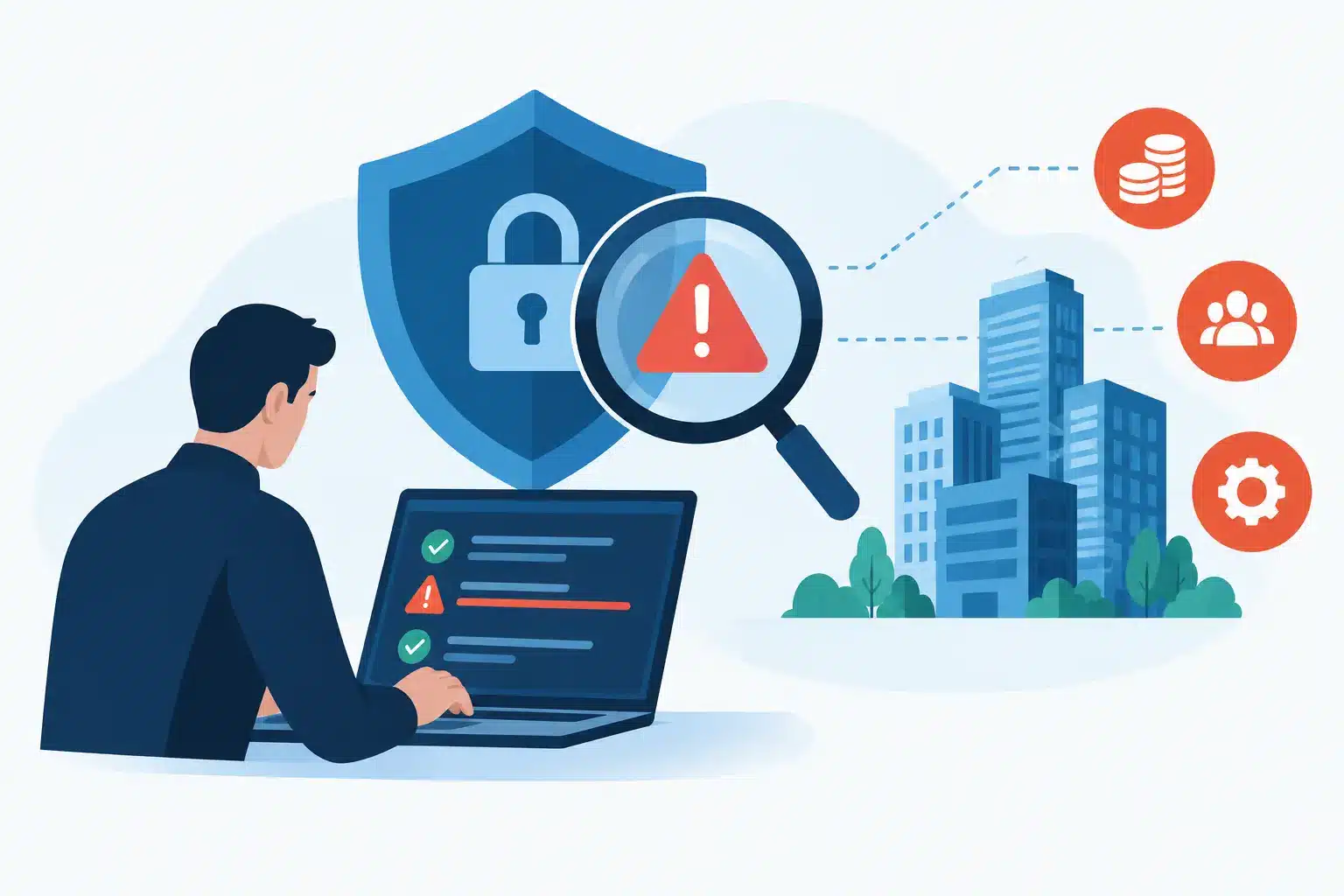
A security report that lists dozens of technical findings but gives no clear route to action creates another problem for the business. Penetration testing should do the opposite. It should show how a real attacker could affect your systems, data and operations, then give your team a practical order of work to reduce that exposure.
For IT leaders, this is not simply a compliance exercise or a test of whether an antivirus alert appears. It is a controlled assessment of the routes an attacker may use to enter, move through and disrupt your environment. Done properly, it turns vague cyber risk into decisions that can be owned, budgeted and completed.
What penetration testing actually tells you
A penetration test is an authorised attempt to identify and safely exploit weaknesses in a business environment. Depending on the agreed scope, it may assess external systems exposed to the internet, internal networks, cloud services, web applications, wireless networks, user behaviour or a mixture of these.
The point is not to prove that every system is perfect. No operating environment stays perfect for long. New software is deployed, staff join and leave, permissions change, suppliers connect in, and a routine configuration adjustment can open an unexpected gap. The purpose is to understand which weaknesses matter most when they are viewed together.
A single missing software update may appear manageable in isolation. Combined with an over-privileged account, weak network separation and accessible backups, it can become a route to significant business disruption. This is why an effective test follows realistic attack paths rather than treating every finding as equal.
For a business, the useful output is clear: which assets are exposed, how an attacker could reach them, what the likely operational impact would be, and what should be fixed first. That may mean protecting customer data, preventing ransomware spread, preserving access to key applications or avoiding downtime in a retail, office or data centre environment.
Why penetration testing matters beyond compliance
Many organisations commission a test because a customer, insurer, regulator or framework asks for one. That can be a valid trigger, but compliance alone is a poor measure of security. A certificate or completed questionnaire does not prove that an exposed service cannot be compromised.
Penetration testing gives decision-makers independent evidence. It can confirm whether controls work as intended and identify where procedures have fallen behind the technology estate. It also helps avoid spending money in the wrong place. If a business is considering a new security tool while basic identity controls or internet-facing systems remain exposed, the priority is usually clear.
It supports more informed conversations with boards and senior leadership, too. Rather than discussing abstract threat levels, IT teams can explain a realistic scenario: an attacker gains access through a remote service, obtains elevated privileges, reaches a file server and disrupts critical operations. That is easier to understand and easier to act on.
There is also a practical insurance benefit. Cyber insurers increasingly expect evidence of controls, patching, multi-factor authentication, backup protection and risk assessment. A recent, well-scoped test will not guarantee cover or replace good security management, but it can demonstrate that risk is being actively assessed and addressed.
The right scope depends on your business
There is no single penetration test that suits every organisation. The right scope depends on your systems, risk profile, operational constraints and the question you need answered.
An external test assesses the systems that can be reached from the public internet. This is often the starting point for businesses with remote access, cloud platforms, online portals or public-facing websites. It examines what an attacker can see without access to your premises or network.
An internal test assumes an attacker, malicious insider or compromised device has gained a foothold. It examines whether they could escalate access, move across the network or reach valuable data and services. For organisations concerned about ransomware, this view is often essential.
Application testing focuses on the software used by customers, employees or partners. It can identify issues such as weak authentication, insecure data handling or flaws that allow users to access information they should not see. Where an application supports revenue, customer trust or a key internal process, testing should reflect its real business importance.
Cloud environments need their own consideration. Responsibility is shared between the cloud provider and your organisation. The provider secures the underlying platform, but your identity settings, access permissions, storage configuration and application deployment remain your responsibility. Testing can reveal where that shared-responsibility boundary has been misunderstood.
Social engineering may also be appropriate, but it requires careful planning. A simulated phishing campaign can test how people and processes respond to deception. It should never be used to embarrass staff. The value lies in improving reporting, training and escalation, while keeping normal operations protected.
A good test is controlled, not disruptive
Business leaders are right to be cautious about testing critical systems. A poorly planned assessment can create noise, disrupt services or confuse internal teams. That is why the preparation phase matters as much as the technical work.
Before testing begins, agree the scope, rules of engagement, testing window, contact points and escalation process. Define which systems are in scope, which are off limits, and whether any techniques require explicit approval. Production systems, operational technology and business-critical applications may need more cautious methods than a standard office network.
The testing provider should also understand your environment. Are there peak trading periods? Is a site operating around the clock? Are there safety, facilities or data centre dependencies? These details influence how the work is carried out. Security testing should reduce uncertainty, not introduce avoidable operational risk.
Clear communication is equally important. Your internal IT team needs enough visibility to support the process, but the test should still retain enough realism to identify gaps in detection and response. The balance depends on the objectives. A fully informed assessment is useful for detailed assurance, while a more limited-notice exercise can test monitoring and incident handling.
What a useful penetration testing report looks like
The report should not leave your team with a pile of findings and a vague instruction to improve security. It should connect technical issues to business impact and give a clear remediation plan.
Expect an executive summary written for decision-makers, alongside technical detail for the people who will carry out the fixes. Findings should be prioritised according to exploitability, likely impact and the value of the systems affected. A critical issue on an isolated test system may need less urgent attention than a moderate issue that exposes a core business application.
The strongest reports show attack chains. They explain how several weaknesses can be combined to reach a meaningful outcome, such as privileged access or access to sensitive records. They should also distinguish between quick actions and longer-term improvements. Closing an unnecessary internet-facing service may be immediate; redesigning identity management or network segmentation may require a planned project.
Retesting matters. Once priority findings have been addressed, a targeted retest provides evidence that the changes work and that a fix has not created an unexpected new issue. This is particularly valuable where results support compliance, client assurance or cyber insurance discussions.
Turning findings into lasting improvement
A penetration test is a point-in-time assessment. It identifies exposure on the day, within the agreed scope. It does not replace patch management, security monitoring, backup testing, access reviews or staff awareness. Those controls are what keep risk from returning between tests.
The most effective businesses use findings to improve their ongoing security programme. They assign owners and deadlines, track remediation through normal governance, and revisit the root causes behind repeated issues. If the same problems reappear each year, the answer is rarely another report. It is usually a gap in process, accountability or day-to-day management.
This is where a joined-up technology partner can make a material difference. WestTech can help businesses connect assessment findings with practical remediation across infrastructure, cloud, identity, managed IT and cyber protection, without forcing internal teams to coordinate multiple suppliers.
Penetration testing delivers its greatest value when it leads to visible change: fewer exposed systems, stronger access controls, clearer recovery plans and greater confidence that the business can continue operating when attackers look for a way in.