
A password reset should not wait behind a complex server issue. Yet in many businesses, both arrive in the same queue, compete for the same technician time and create the same frustration for users. This AI helpdesk automation guide explains how to use AI to remove routine support friction while keeping skilled people in control of the work that affects security, continuity and business operations.
The objective is not to replace your IT team with a chatbot. It is to give users faster answers, reduce avoidable ticket volumes and help technicians focus on incidents that need judgement. Done properly, AI automation improves service without creating another disconnected tool or another layer of risk.
Where AI helpdesk automation creates real value
Most service desks carry a predictable mix of work. Users need help accessing accounts, setting up devices, finding approved software, connecting to printers or understanding basic security prompts. These requests are necessary, but they are not all equally complex.
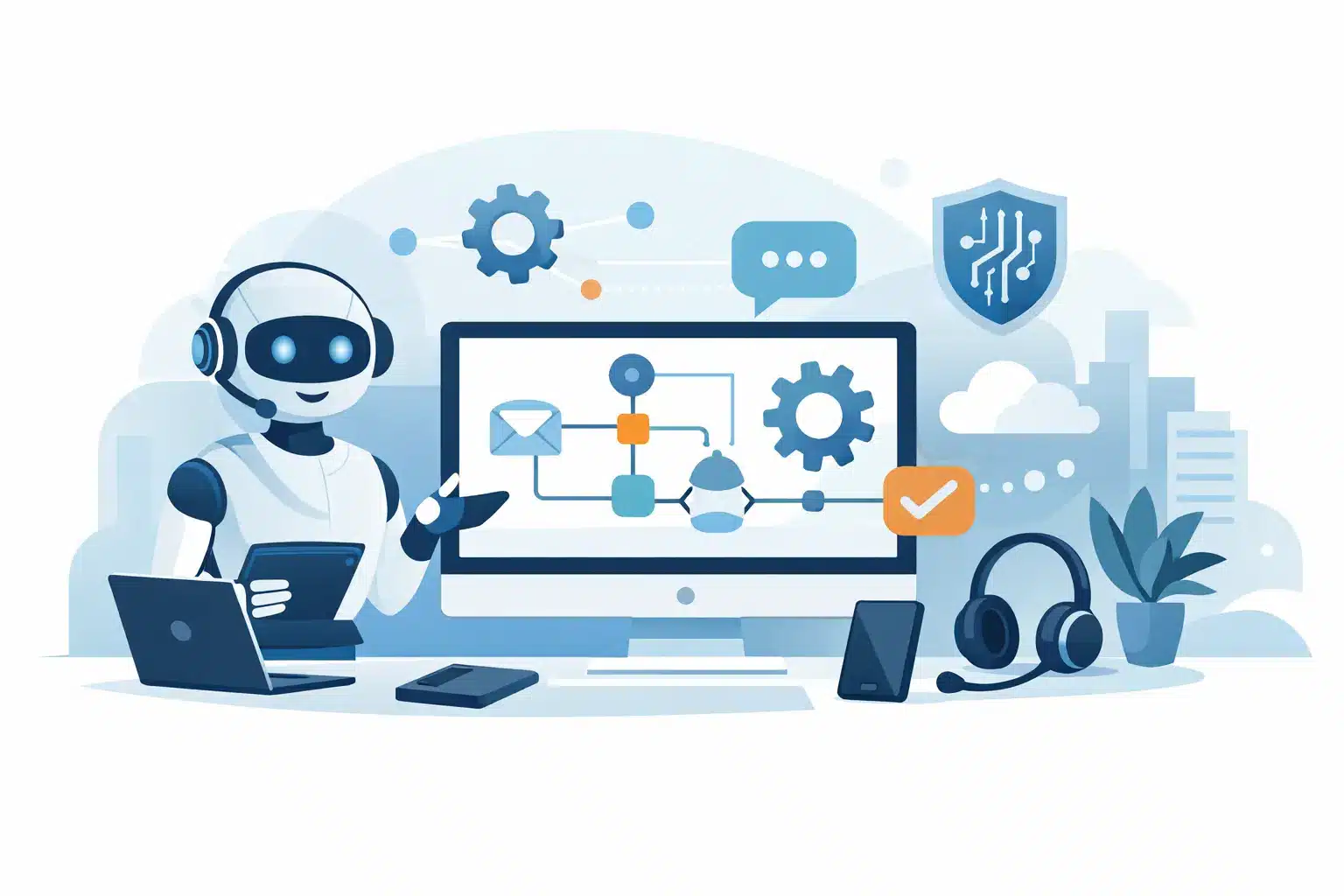
AI can identify the intent behind a request, surface the right knowledge article, collect missing information and trigger an approved workflow. For simple, low-risk issues, it can guide the user through a resolution without a technician having to intervene. For everything else, it can create a better ticket from the start, with a clear summary, relevant device details, business impact and suggested next steps.
That difference matters operationally. A technician should not have to spend ten minutes establishing whether a user has restarted a device, which application is affected or whether an issue is isolated to one person. Better triage means faster resolution, more accurate prioritisation and fewer tickets passed between teams.
The strongest use cases tend to be repetitive, well understood and governed by clear rules. Password and access requests, software guidance, common connectivity issues, new starter queries and status updates are often suitable places to begin. AI can also assist technicians by summarising long ticket histories, drafting clear user updates and suggesting relevant internal documentation.
Start with the service desk, not the software
The wrong approach is buying an AI feature and expecting it to repair an unclear support model. If your ticket categories are inconsistent, your knowledge base is out of date or ownership between IT suppliers is unclear, automation will amplify the confusion.
Start by reviewing the last three to six months of tickets. Look for high-volume request types, repeat incidents, common hand-offs and tickets that take too long to log rather than resolve. Separate genuine technical faults from requests for information or access. This gives you a realistic automation backlog based on business demand, not vendor demonstrations.
Ask three practical questions of every candidate process. Is the request common enough to justify automation? Can it be resolved safely through a documented workflow? Is there a clear escalation point when the AI is unsure or the request falls outside policy?
If the answer to any of these is no, keep a person in the loop. AI is most useful when it handles the predictable first step and routes exceptions quickly. A poorly designed automated process can be more damaging than a slow manual one, particularly where access rights, financial systems or customer data are involved.
Build a knowledge base people can trust
AI answers are only as reliable as the information behind them. A neglected knowledge base produces confident but unhelpful guidance, which erodes trust faster than no automation at all.
Create short, task-based articles for the issues users actually raise. Use plain language, current screenshots where necessary and clear ownership for each article. Policies need the same discipline. If staff are expected to follow a process for reporting phishing, requesting software or accessing shared data, the process must be specific and easy to find.
Set review dates and assign owners. When a recurring ticket reveals a gap in documentation, update the article as part of closing the issue. This turns the service desk into a source of continuous improvement rather than a record of recurring frustration.
Use automation in layers
A controlled rollout is better than a major switch-on. Begin with support functions where the impact of an incorrect response is limited and the workflow is easy to verify. Then extend automation as your data, processes and confidence improve.
The first layer is conversational support. An AI assistant can answer common questions, direct users to approved guidance and gather information before creating a ticket. It should be clear that users can request human support at any point. Hiding the route to a person may reduce apparent ticket numbers, but it does not improve service.
The second layer is workflow automation. Once the request is validated, the service desk can trigger approved actions such as account unlocks, distribution list changes, standard software requests or equipment onboarding tasks. These workflows should include approval gates where policy requires them.
The third layer is technician assistance. AI can categorise incoming tickets, assess likely urgency, identify related incidents and produce handover notes. This is particularly valuable for businesses with lean internal IT teams, where one person may be balancing user support, supplier management, security tasks and strategic projects.
Security and governance cannot be an afterthought
Helpdesk automation sits close to identity, devices, applications and sensitive business information. That makes governance essential. Your AI service should operate within the same security standards expected of any other part of the IT estate.
Define what information the system can access, where data is processed, how long it is retained and who can change its rules or knowledge sources. Confirm that permissions follow least-privilege principles. An AI assistant does not need unrestricted access to every system to answer a basic support question.
Be particularly careful with identity-related requests. A request to reset a password or change multi-factor authentication settings may look routine, but it can also be an attacker’s first attempt to gain access. Build in identity verification, approval requirements and escalation rules. Never allow convenience to bypass security controls.
You also need an audit trail. Business leaders should be able to see what was automated, which actions were taken, when a request was escalated and whether the service met agreed response standards. This is useful for compliance, but it is also how you spot processes that need refinement.
Measure the outcome, not just the ticket count
A falling ticket volume can be positive, but it is not enough on its own. Users may stop logging issues because they have lost confidence in the service desk. Measure the quality of the experience alongside efficiency.
Track first-contact resolution, time to acknowledge, time to resolve, escalation rates and user satisfaction for automated and human-handled requests. Monitor how often users abandon the AI route, request a technician or receive an incorrect answer. These signals tell you where the automation is helping and where it is creating work.
Security metrics matter too. Review failed identity checks, unusual access requests, policy exceptions and AI interactions involving sensitive systems. Automation should make the environment easier to manage, not harder to supervise.
For many organisations, the clearest commercial benefit is capacity. If routine queries are resolved faster, internal IT and managed service teams can spend more time preventing downtime, strengthening cyber controls and planning infrastructure improvements. That is where automation earns its place.
Choosing the right operating model
The technology platform matters, but so does accountability. Some businesses have the internal capability to configure, maintain and govern AI workflows themselves. Others need a technology partner to manage the service desk, knowledge base, security controls and ongoing optimisation as one joined-up operation.
A fragmented model can create avoidable gaps. One provider supplies the helpdesk platform, another manages devices, a third handles cybersecurity and nobody owns the user experience when an automated request fails. A single accountable partner can connect automation to the wider environment, from identity and endpoint management to network performance and incident response.
WestTech approaches automation as part of the wider IT service, not as a standalone feature. The focus should remain on faster support, transparent escalation and practical controls that match your risk profile.
AI helpdesk automation works best when it is treated as an operational improvement programme, not a one-off deployment. Start with the everyday requests that waste user time, prove the controls, listen to the people using the service and expand only where automation makes support more reliable. The best result is simple: users get help quickly, technicians retain control of complex issues and the business has fewer problems competing for attention.