
If your team is losing hours to recurring IT issues, support tickets are piling up, and basic changes take too long to deliver, the question is no longer whether IT needs attention. It is when should a business outsource IT, and whether keeping everything in-house is still the right operational choice.
For many businesses, outsourcing IT is not a last resort. It is a practical decision made when systems become too important, too complex, or too risky to manage in a fragmented way. The right time usually arrives before a major outage, security incident, or failed rollout. The challenge is recognising the signs early enough to act on them.
When should a business outsource IT?
A business should outsource IT when internal support can no longer keep up with operational demand, security expectations, compliance requirements, or growth plans. That point looks different for every organisation, but the pattern is usually the same. The business starts depending more heavily on technology while the support model stays reactive, overstretched, or unclear.
In smaller companies, that might mean one capable employee handling everything from password resets to supplier management and cyber risk. In larger environments, it can mean an internal team spending so much time firefighting that projects, upgrades, and strategic planning are constantly delayed. In both cases, the result is the same – IT becomes a bottleneck instead of an enabler.
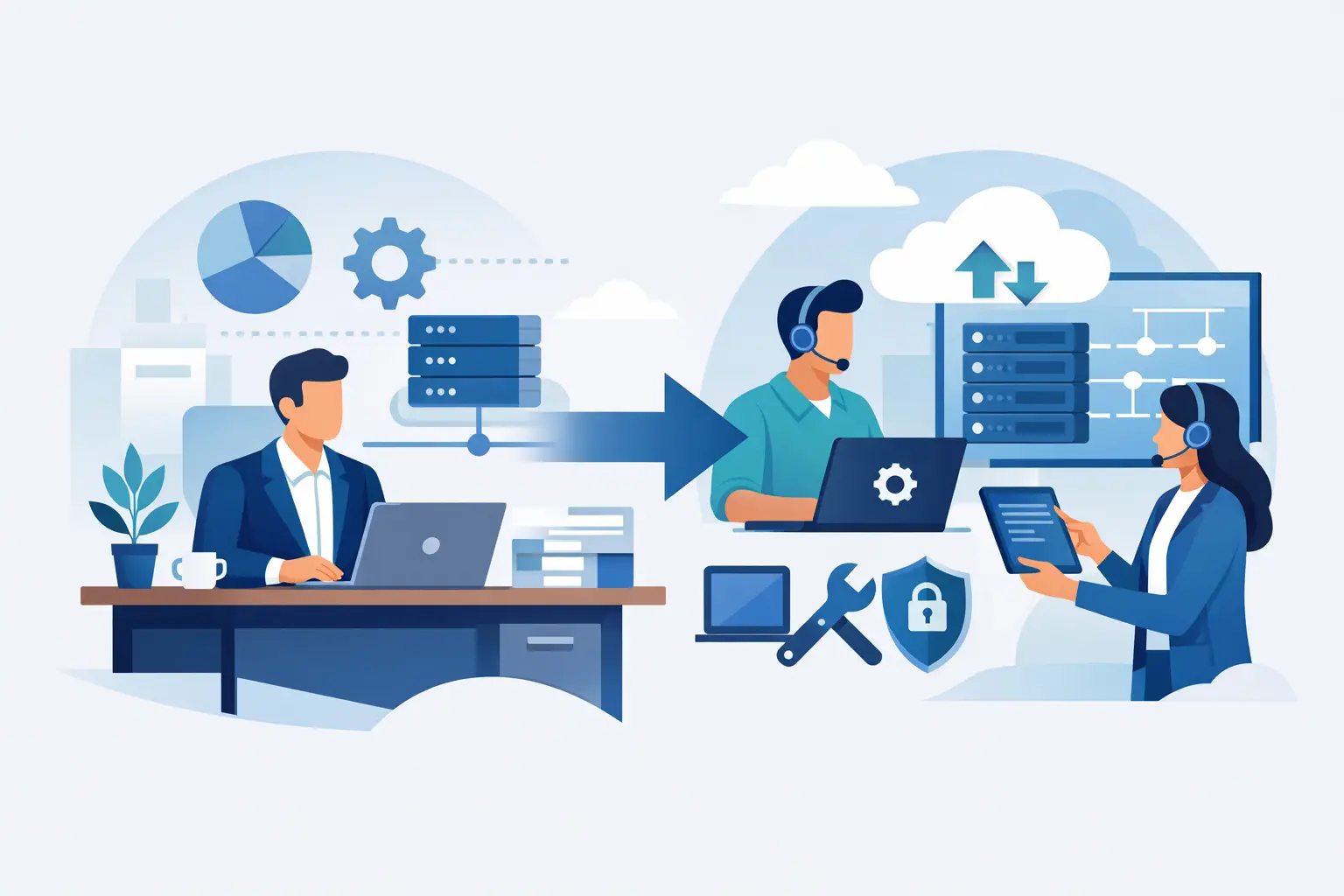
Outsourcing makes sense when it gives the business more control, not less. That is an important distinction. The goal is not to hand over responsibility and hope for the best. The goal is to gain reliable support, better visibility, faster resolution, and access to broader expertise without building a larger internal function from scratch.
The clearest signs your business has outgrown its current IT model
One of the strongest indicators is recurring downtime. If staff regularly cannot access systems, calls are dropped, devices fail, or connectivity problems keep resurfacing, the business is already paying for poor IT support through lost productivity. Downtime is rarely just a technical issue. It delays sales, frustrates employees, affects customer experience, and pulls management attention into problems that should have been prevented.
Security pressure is another major trigger. Many businesses reach a point where antivirus and basic passwords are no longer enough, but they do not have the in-house capacity to manage cyber security properly. If your team is unsure about patching, endpoint protection, access control, backup testing, phishing response, or cyber insurance requirements, outsourcing is often the more responsible option.
Growth can create the same pressure. Opening a new site, expanding headcount, rolling out new devices, moving to cloud platforms, or integrating acquisitions all place heavier demands on IT. A setup that worked for 20 users often fails at 80. Processes that were manageable in one office become inconsistent across multiple locations. At that stage, outsourced IT can provide structure, standards, and implementation support that an overstretched internal team may struggle to deliver.
There is also the issue of vendor sprawl. Many businesses end up with one supplier for telecoms, another for cyber security, a separate AV installer, different software providers, and no single point of accountability when something breaks. That creates delays, finger-pointing, and hidden cost. If your organisation is spending too much time coordinating multiple providers, outsourcing to one accountable partner can remove friction quickly.
Cost is part of the decision, but not in the way most businesses expect
Some leaders ask when should a business outsource IT because they want to cut costs. Sometimes that happens. More often, the real advantage is cost predictability and better value from spend that already exists.
Internal IT is not just salary. It includes recruitment, training, cover for holidays and sickness, tools, monitoring platforms, security products, project delivery capacity, and specialist skills that may only be needed occasionally. For many SMBs and mid-market businesses, building all of that internally is expensive and difficult to sustain.
That said, outsourcing is not automatically cheaper in every scenario. A business with a mature internal IT department, strong specialist coverage, and well-defined processes may keep core functions in-house and outsource only selected areas. It depends on scale, complexity, and risk appetite.
The better question is whether your current model gives you the support level the business actually needs. If you are paying for recurring fixes, emergency callouts, delayed projects, and inconsistent security, your costs may already be higher than they appear on paper.
When outsourcing works best alongside an internal team
Outsourcing IT does not always mean replacing internal capability. In many cases, it strengthens it.
An internal IT manager may understand the business well but still need external support for 24/7 monitoring, cyber security, compliance work, infrastructure projects, cloud migrations, or escalations. That hybrid model can be highly effective. Internal teams stay close to users and business priorities, while an outsourced partner provides depth, resilience, and delivery capacity.
This matters for organisations that do not want to lose strategic control. Outsourcing should not reduce visibility or create dependency on black-box support. A good provider works transparently, documents properly, reports clearly, and helps your team make better decisions. The relationship should feel like an extension of your operations, not a hand-off.
The risks of waiting too long
Businesses often delay outsourcing because the current setup still feels manageable. Systems are running, people are coping, and major failures have not happened yet. That can be misleading.
IT problems usually build quietly before they become urgent. Backups are untested. Devices age past support windows. Permissions remain too broad. Office moves or refurbishments happen without enough technical planning. Security controls are inconsistent between users or sites. None of this may cause an immediate crisis, but together they increase operational and commercial risk.
Waiting too long usually means outsourcing only after something expensive has gone wrong. A ransomware event, prolonged outage, failed audit, poor relocation, or botched infrastructure project often reveals how exposed the business really is. At that point, the provider is being asked to stabilise an already difficult situation rather than improve a healthy environment.
Acting earlier gives you more options. It allows time to assess systems properly, standardise support, improve resilience, and plan change in a controlled way.
How to decide if now is the right time
A useful starting point is to look at business impact rather than technical detail. Are IT issues affecting staff productivity? Are projects delayed because nobody has capacity to deliver them? Are security responsibilities clear and actively managed? Can the business scale without adding avoidable complexity? Do you know who is accountable when something fails?
If the answer to several of those questions is no, outsourcing is worth serious consideration.
It also helps to assess how much of your current IT effort is reactive. If your team or suppliers mainly respond after problems occur, you are unlikely to get consistent long-term performance. Strong outsourced support should be proactive. That means monitoring, maintenance, lifecycle planning, security management, user support, and clear communication before small issues become costly ones.
The right partner should also be able to support more than a narrow helpdesk function. Many businesses need joined-up delivery across infrastructure, cyber security, compliance, connectivity, office technology, and site requirements. A fragmented model creates operational drag. A provider that can take ownership across design, deployment, maintenance, and support removes that complexity.
For businesses looking for exactly that kind of accountability, WestTech reflects the model many decision-makers now prefer – one partner responsible for keeping critical technology working, secure, and aligned with business needs.
What good outsourcing should feel like
When IT is outsourced well, the business feels the difference quickly. Issues are resolved faster. Users know where to go for help. Security stops being vague. Projects move forward with less friction. Leadership gets clearer reporting and fewer unpleasant surprises.
Just as importantly, the business regains time. Operations leaders can focus on continuity and growth instead of chasing suppliers. Internal IT staff can focus on higher-value work rather than constant firefighting. Facilities and infrastructure teams can deliver changes with proper technical coordination rather than patching things together under pressure.
That is usually the real answer to when should a business outsource IT. It is the point where technology has become too central to leave unsupported, too risky to manage reactively, or too complex to coordinate across too many disconnected providers.
The right moment is often earlier than businesses think. If your IT is draining time, increasing risk, or slowing growth, waiting for a bigger problem rarely improves the decision.