

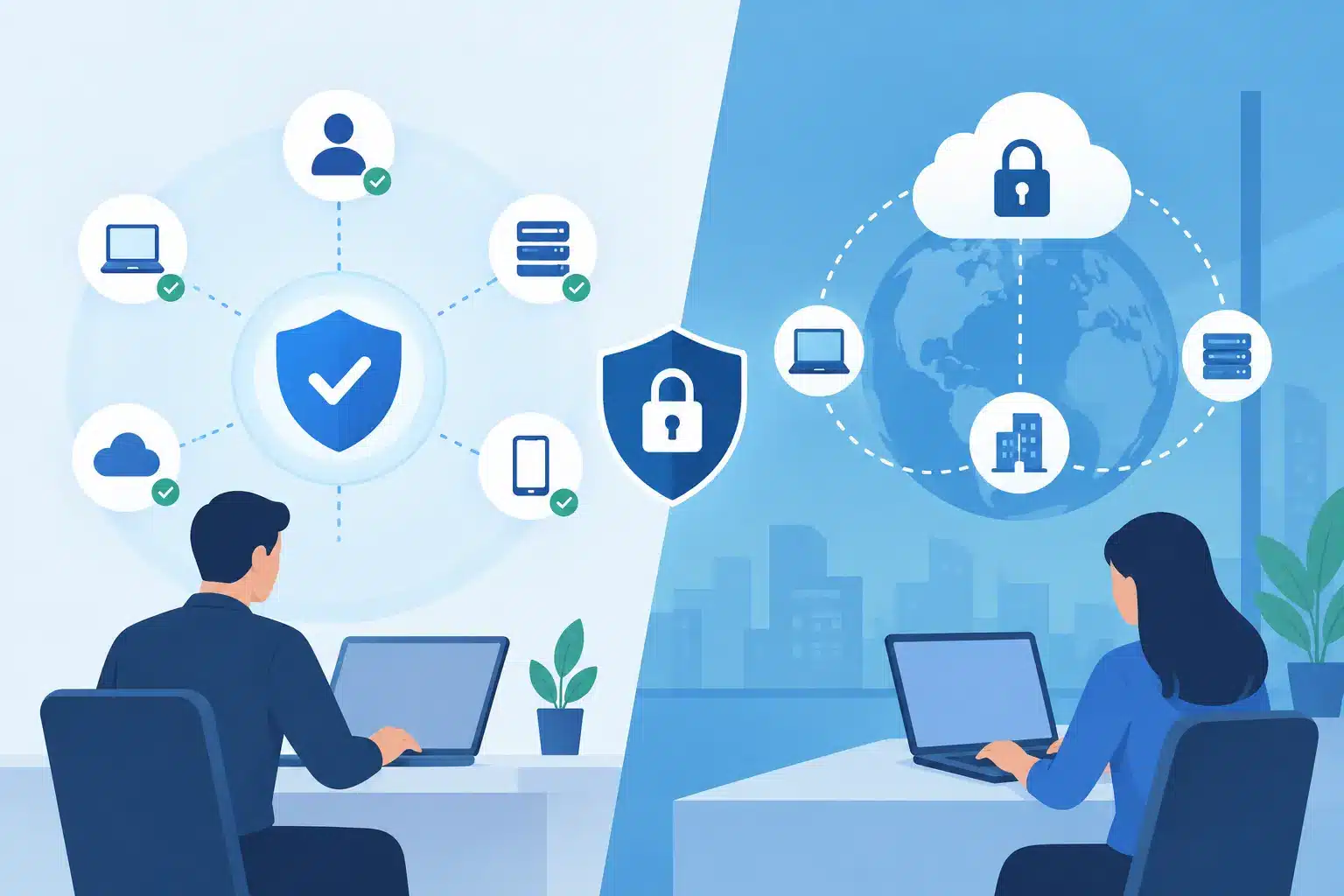
A remote worker signs in from home, a contractor needs access to one application, and an office manager is trying to reach a file server from a hotel network. These are not unusual requests. The question is whether your access model can support them without giving each user a broad route into the business. That is where the zero trust vs VPN decision becomes practical rather than theoretical.
For many organisations, VPNs remain useful and familiar. They can connect employees to internal systems quickly, particularly where applications still sit on-site or in a private cloud. But remote access has changed. Users work from more locations, applications are spread across cloud and on-premise environments, and a stolen password can create far more risk than it once did.
Zero trust is designed for that reality. It limits access to what a person needs, verifies each request using multiple signals, and reduces the damage that can follow a compromised account or device. It is not automatically the right replacement for every VPN, but it is changing how businesses should plan access security.
Zero trust vs VPN: the fundamental difference
A traditional VPN creates an encrypted tunnel between a user’s device and the business network. Once connected, the user may be able to reach a wide range of systems, depending on how the VPN and internal network are configured. Controls can limit this access, but many older deployments were designed around the assumption that a connected user is largely trusted.
Zero trust works from a different starting point: no user, device or connection should receive implicit trust simply because it is inside the network perimeter. Access is verified continuously and granted at the application, service or data level. A user accessing a finance platform, for example, should not automatically gain visibility of the wider server estate.
This is often described as moving from network access to resource access. The distinction matters. A VPN asks, “Can this person connect to our network?” Zero trust asks, “Can this verified person, on this compliant device, access this specific resource right now?”
Neither model is a product in isolation. VPN is a connection method. Zero trust is a security approach supported by identity management, multi-factor authentication, device controls, application access policies, monitoring and clear governance.
Why broad network access creates avoidable risk
VPNs are not inherently insecure. A well-configured VPN protected by multi-factor authentication, regular patching and segmented networks can remain an effective control. The issue is that many businesses have accumulated remote-access arrangements over time. Shared credentials, unmanaged devices, overly broad permissions and legacy servers can turn a useful tool into an easy route for attackers.
When an attacker gains a VPN credential, they may appear to be a legitimate user. If that account can see large parts of the network, the attacker has time to move between systems, identify valuable data and disrupt operations. This is known as lateral movement, and it is one reason ransomware incidents can spread beyond the first compromised device.
Zero trust reduces this exposure by applying least-privilege access. Users receive only the permissions required for their role and task. Access can also depend on context: whether multi-factor authentication has been completed, whether the device is encrypted and up to date, where the request comes from, and whether the behaviour looks unusual.
That does not eliminate risk. No access model can. It does contain it more effectively when a password is phished, a laptop is lost or a third party account is misused.
Where VPNs still make commercial sense
Replacing every VPN immediately is rarely necessary or commercially sensible. Many organisations rely on specialist line-of-business systems that require network-level connectivity. IT teams may need secure administrative access to infrastructure. Site-to-site VPNs can also provide a dependable way to connect offices, warehouses or other fixed locations.
A VPN may be the sensible option where the application cannot support modern identity-based access, the workforce is relatively small and stable, or the requirement is temporary while systems are being modernised. The key is to treat it as a managed security service, not a set-and-forget connection.
At a minimum, a business should know who has VPN access, which systems they can reach, whether multi-factor authentication is enforced, and whether accounts are removed promptly when roles change. Network segmentation is equally important. A remote user who only needs one server should not have unrestricted visibility of every device in the environment.
The operational trade-off is straightforward. VPNs can be quicker to deploy for legacy requirements, but they often create more ongoing work around permissions, network design and troubleshooting. They can also frustrate users when performance is poor or every application must route through the corporate network.
Where zero trust delivers stronger control
Zero trust is especially effective when employees, partners and contractors need access to a defined group of cloud applications, internal web applications or sensitive data. Rather than placing them on the network, it provides controlled access to the resource itself.
For a growing business, this can simplify onboarding and offboarding. New staff can be assigned access according to their role. Contractors can receive time-limited permissions to one platform. When an employee leaves, access is removed centrally rather than relying on someone to remember every shared system and remote connection.
It can also improve the user experience. Employees may sign in once through a managed identity platform and access approved applications without launching a VPN client or waiting for traffic to travel through a central gateway. That said, this depends on sound implementation. Poorly designed access policies can create repeated sign-in prompts and support calls instead of a smoother experience.
Zero trust also supports stronger visibility. Security teams can see which users accessed which applications, from which devices and under what conditions. Those records are valuable when investigating an incident, meeting customer security expectations or demonstrating control for compliance purposes.
The controls that make the model work
Zero trust should not be treated as a licence purchase or a quick policy change. Its effectiveness depends on several connected controls working together:
- Identity security: Unique user accounts, strong multi-factor authentication and role-based permissions reduce reliance on passwords alone.
- Device assurance: Access policies should check that devices are managed, encrypted, patched and protected before allowing sensitive activity.
- Application segmentation: Users should be granted access to individual applications and services rather than the entire network by default.
- Monitoring and response: Unusual sign-ins, impossible travel, failed authentication attempts and unexpected data activity need review and action.
- Lifecycle management: Joiners, movers and leavers processes must update permissions quickly and consistently.
These controls also improve a VPN environment. That is why the best question is often not “VPN or zero trust?” but “Which access method is appropriate for each user, system and risk level?”
Choosing the right approach for your environment
Start with the applications people need to reach and the data they handle. A cloud-based finance platform, an internal engineering system and a legacy server may each require a different access method. Grouping every requirement under one remote-access solution usually leads to unnecessary complexity or unnecessary exposure.
Next, review identity and permissions. If your business cannot confidently answer who has access to critical systems, from which devices and for what reason, moving to zero trust will expose a governance gap that needs addressing. That is not a reason to delay. It is a reason to plan the project properly.
Device management should be part of the decision. Zero trust policies are most effective when company devices are enrolled, secured and monitored. Businesses supporting personal devices may need separate controls, restricted access or browser-based application access for higher-risk activities.
Finally, account for legacy infrastructure. Some systems will not move to modern access models quickly. A phased approach is usually safer: protect high-risk cloud services and privileged accounts first, tighten VPN controls for remaining legacy access, then modernise applications as budgets and operational priorities allow.
A practical path forward
The most reliable programmes begin with an access assessment, not a forced technology swap. Map users, devices, applications and third parties. Identify accounts with privileged access. Remove dormant permissions. Apply multi-factor authentication where it is missing, then prioritise systems where broad network access presents the greatest business risk.
This approach gives leadership a clearer investment case. Instead of buying security tools because they sound current, you can measure reduced exposure, simpler user administration, better audit evidence and less dependence on a single network perimeter.
For organisations balancing cloud adoption, compliance requirements and legacy infrastructure, WestTech can help turn that assessment into an operational plan with clear ownership. The right destination is not a fashionable label. It is an access model that lets people work efficiently while making a compromised account far less damaging.