

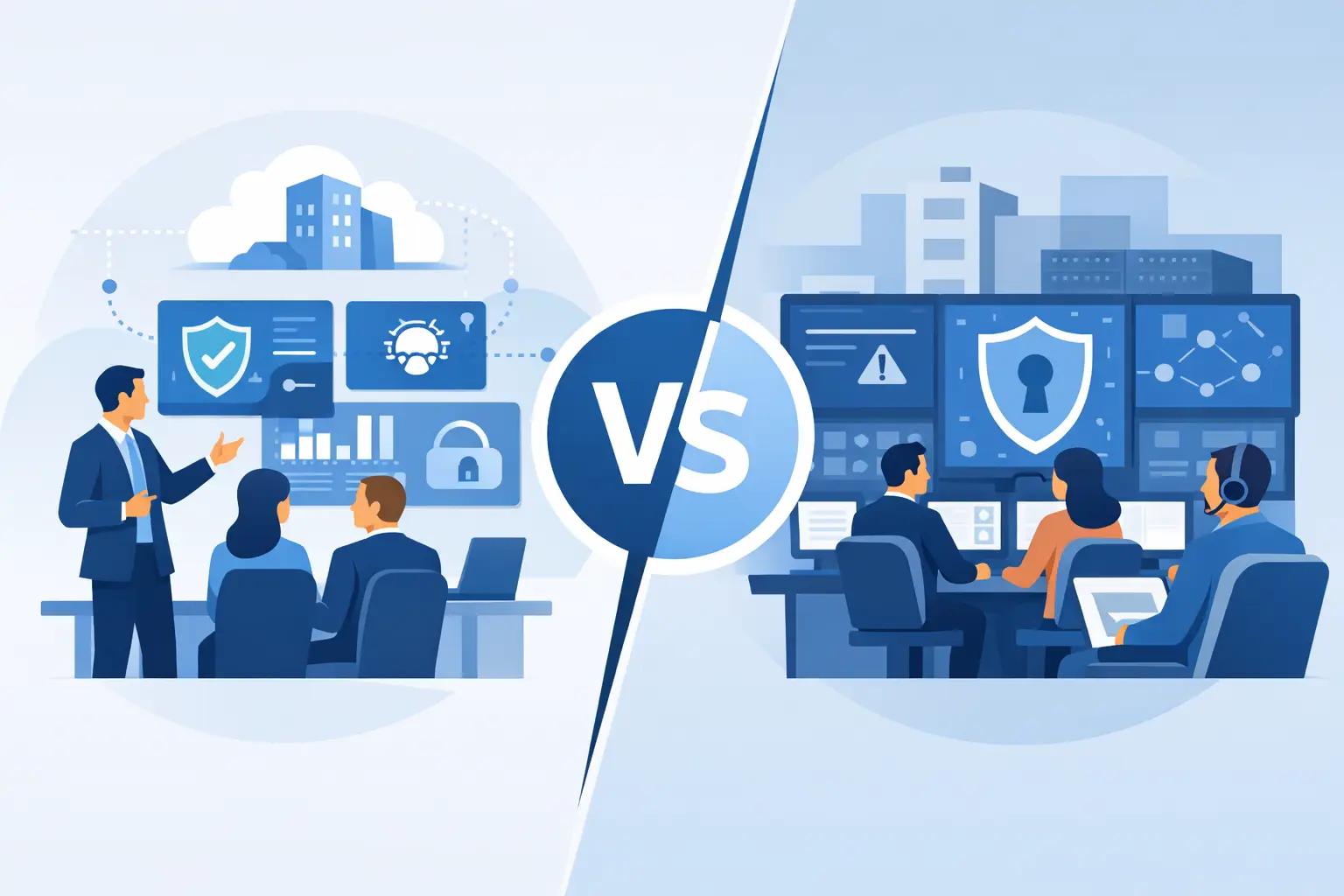
At 2am, a real security incident does not care whether your team is short-staffed, your SIEM rules need tuning, or your best analyst is on annual leave. That is where the managed SOC vs in house decision becomes less about preference and more about operational reality. For most businesses, the question is not which model sounds stronger on paper. It is which one can detect threats quickly, respond properly, and keep risk under control without draining internal resources.
Why the managed SOC vs in house choice matters
A Security Operations Centre is not just a toolset. It is an operating model. It combines people, monitoring, investigation, incident response processes, threat intelligence, reporting, and constant tuning. Businesses often underestimate how much work is required to make a SOC effective day after day.
That matters because a weak SOC can create false confidence. You may have dashboards, alerts, and expensive platforms, yet still miss suspicious behaviour or fail to respond in time. The right model should improve visibility, reduce dwell time, and support business continuity, not simply add another layer of complexity.
What an in-house SOC gives you
An in-house SOC means your organisation builds and runs its own internal security operations capability. Your team owns the tooling, the workflows, the staffing, and the day-to-day monitoring.
The biggest advantage is control. Internal teams usually have a stronger understanding of your business systems, user behaviour, critical assets, and internal politics. That context can matter when deciding whether an event is routine noise or a genuine threat. It can also help when investigations need to move quickly across departments.
An in-house setup may also appeal if you have strict governance requirements, sensitive environments, or an existing security function with mature leadership. In those cases, keeping operations internal can feel more aligned with your risk posture.
The difficulty is scale. A SOC is hard to run well unless you can support 24/7 coverage, recruit skilled analysts, retain them, and give them the tools and processes they need. Security talent is expensive. Turnover is common. Tooling costs add up fast. Coverage gaps appear quickly if the team is lean.
Many businesses start with an in-house ambition and then realise they have built a partial SOC rather than a complete one. They may have daytime monitoring, some alert triage, and a few response playbooks, but not true around-the-clock capability.
What a managed SOC gives you
A managed SOC outsources some or all of your security monitoring and response function to a specialist provider. The provider supplies the analysts, processes, monitoring coverage, and often the tooling or tooling management as part of the service.
The immediate advantage is speed to capability. Instead of hiring and building from scratch, you gain access to an established operational team. That usually means broader coverage, faster onboarding, and a more mature service model from day one.
A managed SOC can also improve consistency. Established providers do this work across multiple client environments, so they tend to have better-tested escalation paths, stronger tuning practices, and more experience spotting common attacker behaviour. For businesses that need better protection quickly, that is a practical advantage.
The trade-off is that not all managed SOC services are equal. Some providers are highly responsive and operationally strong. Others are little more than alert forwarding services. If the service lacks context, clear communication, or defined ownership, your internal team can still end up carrying too much of the burden.
Managed SOC vs in house on cost
Cost is where many decisions begin, but it should not end there.
An in-house SOC can look attractive if you already have security staff and existing tools. However, the true cost usually includes far more than salaries. You need shift coverage, training, certifications, detection engineering, threat intelligence, case management, reporting, and management oversight. Add licensing, infrastructure, and retention challenges, and the budget climbs quickly.
A managed SOC usually moves more of that cost into a predictable service model. That can be easier to plan for, especially for SMBs and mid-market businesses that need enterprise-grade monitoring without enterprise-sized headcount. It also reduces the hidden cost of trying to assemble specialist security capability from a general IT team.
That said, managed services are not automatically cheaper in every case. Large organisations with mature internal security teams may find that in-house operations become more cost-effective at scale. It depends on your size, your risk exposure, and how much capability you already have.
Coverage, response times and resilience
This is often the deciding factor.
Security monitoring only works when it is active at the moment something happens. If your in-house team covers business hours but an attacker moves overnight or over a bank holiday weekend, your response window may already be too slow. Even well-run internal teams struggle to maintain 24/7 operations without significant investment.
Managed SOC services are often built around continuous monitoring. That gives businesses broader coverage without needing to staff a full internal rota. It also reduces single points of failure. One person leaving, being off sick, or moving roles should not weaken your entire security operation.
For businesses focused on uptime, compliance, and operational continuity, resilience matters as much as raw technical capability. A security model that depends on two or three overstretched internal people is rarely resilient.
Control versus accountability
This is where the managed SOC vs in house debate becomes more nuanced.
In-house teams offer direct oversight. You control priorities, internal escalation, and process design. For some organisations, especially those with regulated or highly bespoke environments, that level of control is valuable.
Managed SOC services shift more responsibility to an external partner. That can be a strength if the provider is accountable, transparent, and operationally aligned with your business. It can be a weakness if responsibilities are vague and your team is left chasing updates during an incident.
The best outsourced models do not remove your control. They strengthen execution. You still set the business priorities and risk appetite, while the provider delivers monitoring, triage, and response support with clear ownership. That is often the difference between outsourcing a task and gaining a partner.
Skills and operational maturity
Technology alone does not make a SOC effective. People and process do most of the heavy lifting.
An internal SOC can be excellent when led by experienced security professionals who know how to build use cases, tune detections, reduce noise, and manage incidents calmly. The challenge is finding and keeping those people.
A managed SOC gives access to a wider pool of specialist skills without forcing you to recruit every function yourself. That can include threat analysts, incident responders, and engineers who maintain and improve the monitoring environment over time. For many businesses, that is the fastest route to a more mature security posture.
If your current team is strong in infrastructure and support but not built for round-the-clock threat operations, outsourcing can close the gap without putting unfair pressure on internal IT.
When in-house makes sense
In-house is usually the better fit if you have the budget, the leadership, and the need for deep internal control. It can also work well if your environment is highly specialised and your business already has mature security operations capability.
It is a stronger option when security is treated as a core internal function rather than an add-on, and when you can support continuous improvement rather than just initial deployment. Without that commitment, the model often underdelivers.
When a managed SOC makes sense
A managed SOC is often the better choice when you need strong security operations quickly, want predictable service, and cannot justify building a full internal team. It is particularly well suited to growing businesses, multi-site operations, and organisations that need cyber resilience without adding internal complexity.
It also makes sense when your internal team is already stretched. If they are focused on user support, infrastructure, cloud, projects, and compliance, expecting them to run an effective SOC as well can create risk in every direction.
For businesses that value faster response, simpler management, and single-provider accountability, a managed model can be commercially and operationally stronger. This is especially true when delivered by a partner that understands the wider IT and security environment, not just the alert queue.
A hybrid model is often the practical answer
It does not always have to be one or the other.
Some businesses keep strategic security leadership and internal decision-making in house while outsourcing monitoring, triage, and first-line response. That hybrid approach gives you business context internally and broader operational coverage externally. It can be a sensible middle ground if you want more control than a fully outsourced service but more resilience than a small in-house team can provide.
This model works best when roles are clearly defined. Who investigates, who approves containment, who communicates with leadership, and who owns remediation all need to be agreed in advance.
Choosing the right model for your business
The right answer comes down to a few hard questions. Do you need 24/7 coverage? Can you recruit and retain security analysts? Do you have the internal maturity to tune and manage a SOC properly? Is your current team already overloaded? Are you looking for more control, or better execution?
If the honest answer is that your business needs stronger protection but not more operational burden, a managed service is usually the more realistic route. If you already have mature security leadership, stable funding, and a clear reason to keep operations internal, in-house may be justified.
The strongest security model is the one that works consistently when the pressure is on. Not the one that looks impressive in a strategy document.
A good SOC should help your business move faster with less risk. If it adds confusion, gaps, or management overhead, it is the wrong model – no matter how it is labelled.