

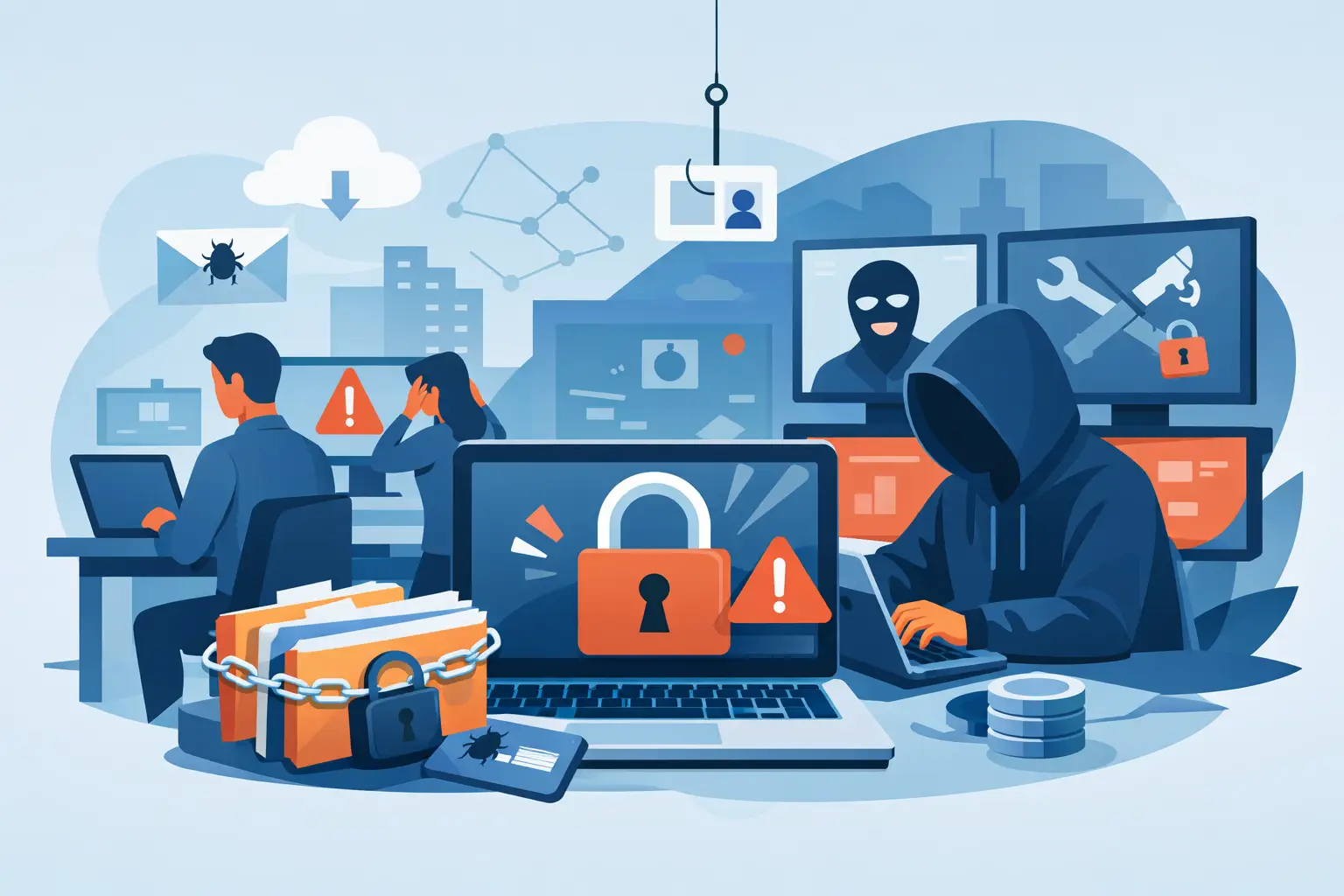
A finance lead opens what looks like a supplier invoice. An operations manager approves a login prompt that seems routine. A server with an unpatched flaw is left exposed for a few weeks longer than planned. That is usually how the damage starts – not with a dramatic hack, but with a chain of small gaps that were easy to miss.
If you are asking what causes ransomware attacks, the honest answer is rarely one thing. Most incidents happen when technical weaknesses, human error, and poor visibility line up at the same time. Attackers do not need a perfect opportunity. They only need one route in, enough access to move through the environment, and a business that cannot afford much downtime.
What causes ransomware attacks in practice
Ransomware attacks are caused by a mix of access, opportunity, and pressure. Access comes from stolen credentials, phishing emails, vulnerable remote services, insecure third-party connections, or devices that are not properly managed. Opportunity comes from patching delays, weak monitoring, poor backup discipline, and too much trust between systems. Pressure is what makes ransomware so effective – businesses rely on their systems every hour of the day, so attackers know disruption can force fast decisions.
That matters because ransomware is no longer just about encrypting files on one machine. In many cases, attackers spend days or weeks inside a network before they trigger anything. They look for backup repositories, shared storage, finance systems, user directories, and administrative tools. The aim is simple: increase operational pain and reduce your room to manoeuvre.
The most common causes of ransomware attacks
Phishing and social engineering
Phishing remains one of the most common entry points. It works because it targets people in the middle of busy working days. A message can look like a delivery update, an invoice, a password reset request, or a document shared by a colleague. If one person clicks, signs in, or runs a file, that can be enough to hand over access.
The real issue is not that employees are careless. It is that attackers are good at imitating normal business activity. That is why awareness training matters, but training alone is not enough. Email filtering, multi-factor authentication, and strong endpoint protection all need to sit behind the user.
Weak or stolen passwords
If passwords are reused, predictable, or shared across teams, attackers have an easier path in. Credentials are regularly bought and sold, harvested through phishing, or exposed in earlier breaches. Once a valid account is compromised, an attacker may not need to exploit any software weakness at all.
This becomes more serious when privileged accounts are poorly controlled. If admin access is broader than it should be, ransomware can spread faster and hit more critical systems. The difference between a contained issue and an operational outage often comes down to how tightly access is managed.
Unpatched systems and outdated software
Attackers actively scan for known vulnerabilities in firewalls, VPNs, servers, operating systems, and business applications. When patches are delayed, those weaknesses stay open. In many organisations, patching slips because internal teams are stretched, older systems are hard to maintain, or updates risk disrupting live operations.
That trade-off is real. You cannot always patch everything immediately, especially in complex environments. But if there is no risk-based patching plan, no asset visibility, and no compensating controls, the exposure grows quickly. Ransomware groups count on that delay.
Remote access exposed to the internet
Remote desktop services, VPN appliances, and remote management tools are frequent targets. If they are exposed directly to the internet, protected by weak credentials, or missing multi-factor authentication, they can become a straightforward entry point.
This is especially common in businesses that scaled remote work quickly or rely on several suppliers to manage different parts of the estate. Over time, remote access can become fragmented. Old accounts remain active, temporary exceptions become permanent, and nobody has a complete picture of who can get in and how.
Poor network segmentation
One compromised device should not give an attacker access to everything else. Yet in many environments, users, servers, backups, and line-of-business systems are still too closely connected. Once inside, ransomware can then move laterally across the network with limited resistance.
Segmentation is not glamorous, but it changes outcomes. If finance, operations, production, and backup environments are separated properly, an attacker has to work harder, makes more noise, and is easier to detect before serious damage is done.
Why businesses are targeted
Ransomware is driven by commercial logic. Attackers target businesses because businesses need continuity. They need payroll to run, orders to process, systems to stay live, and customer service to keep moving. The more operational dependence there is, the more leverage an attacker believes they have.
That is why size does not guarantee safety. Smaller organisations are often targeted because they may have fewer dedicated security resources. Mid-market businesses are attractive because they have valuable data and complex systems but not always enterprise-grade controls. Larger firms can become targets because of their scale, supplier networks, and dependence on uptime.
There is also an industry factor. Sectors with time-sensitive operations, regulated data, or multiple sites can be especially exposed. Retail, professional services, healthcare, logistics, manufacturing, and multi-site office environments all present different pressure points. Attackers look for the pressure point that will hurt most.
What causes ransomware attacks to spread so quickly
Initial access is only part of the problem. The real damage often comes from what happens next. If monitoring is weak, unusual behaviour can go unnoticed. If endpoint controls are inconsistent, malicious tools can run without challenge. If backup systems are reachable from the production network, they can be encrypted or deleted before anyone reacts.
A lack of tested incident response also makes things worse. Many businesses have a policy document somewhere, but not a practical plan that people can use under pressure. When roles are unclear, decisions slow down. That gives attackers more time.
Third-party risk can add another layer. A supplier with access to your environment, poorly managed integrations, or unmanaged devices connecting into the estate can all widen the attack surface. This is one reason vendor sprawl creates security problems as well as operational ones. If responsibility is split across too many providers, accountability gets blurred.
The internal conditions that make attacks more likely
Most ransomware incidents reveal operational weaknesses that existed long before the attack. There may be no complete asset inventory. Legacy systems may still be running because replacement keeps getting pushed back. Cybersecurity tools may be in place but not properly configured, reviewed, or integrated. Users may have local admin rights they do not need. Backups may exist, but recovery testing may be inconsistent.
None of this means a business has been negligent. In many cases, it reflects growth, change, and competing priorities. A company expands, opens new locations, adopts cloud platforms, brings in specialist software, and adds suppliers. Security controls do not always evolve at the same pace.
That is why ransomware prevention is not just a technology question. It is an operational discipline. You need visibility, ownership, clear standards, and routine follow-through.
Reducing the causes of ransomware attacks
The strongest defence is layered. Staff need to recognise suspicious messages, but email security should still block what it can. Systems need patching, but critical services should also be monitored for abnormal behaviour. Backups matter, but they must be isolated, immutable where possible, and tested against real recovery scenarios.
Access control deserves particular attention. Multi-factor authentication should be standard, especially for remote access and admin accounts. Privileged access should be restricted, reviewed, and separated from day-to-day user activity. Devices should be managed consistently, whether they are on-site or remote.
Businesses also benefit from reducing complexity. When infrastructure, support, cybersecurity, and supplier management are handled in silos, gaps appear between handovers. A joined-up approach gives you a clearer view of assets, risks, and response paths. That is one reason many organisations work with a single accountable partner such as WestTech – not simply for support, but for control.
Why the answer is usually broader than malware
When leaders ask what causes ransomware attacks, they are often looking for the malicious file, the compromised account, or the missed patch. Those matter. But the larger cause is usually a lack of control across the environment.
Ransomware succeeds where visibility is weak, responsibilities are fragmented, and resilience has not been tested under real conditions. It thrives in environments where teams are already stretched and downtime would be expensive. That is why the right response is not panic buying another security tool. It is building a more disciplined, better-managed estate where risk is reduced before someone tries their luck.
The practical question for any business is not whether ransomware exists. It is whether your current systems, suppliers, and internal processes would make an attack difficult to start, difficult to spread, and difficult to monetise.