
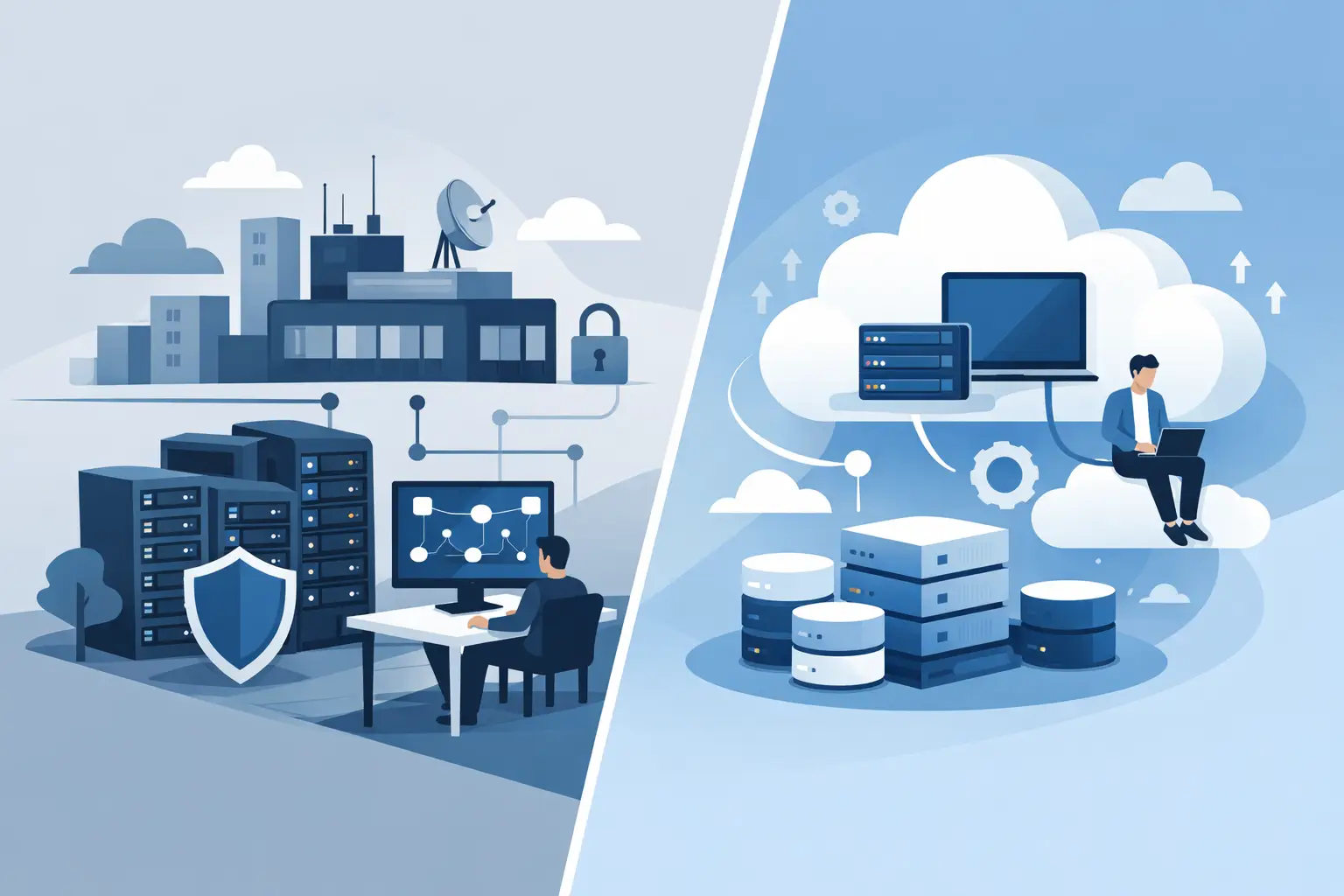
When a server fails at 10am on a Monday, the debate around on-premises vs cloud infrastructure stops being theoretical. It becomes a business continuity issue, a cost issue, and often a customer experience issue as well. For most organisations, the real question is not which model sounds more modern. It is which one gives the business the right level of control, resilience, security and flexibility without creating extra operational drag.
On-premises vs cloud infrastructure: what is the real difference?
On-premises infrastructure means your servers, storage, networking and related systems are hosted within your own site or dedicated facility under your control. Your team, or a managed provider, is responsible for maintenance, upgrades, monitoring, power, cooling, backup strategy and physical security.
Cloud infrastructure shifts those core resources into a provider-managed environment. Instead of owning and housing the hardware yourself, you consume computing, storage and services as needed. That changes how you pay, how you scale and how quickly you can deploy.
The technical difference is straightforward. The business difference is where most decisions are won or lost. One model gives you more direct ownership. The other gives you more agility. Neither is automatically better in every situation.
Why this decision matters beyond IT
Infrastructure choices affect more than your server room. They shape downtime risk, compliance posture, budgeting, support complexity and how quickly the business can respond to change.
If your organisation is opening new sites, supporting hybrid working, rolling out digital systems across multiple locations or handling regulated data, infrastructure becomes a board-level issue. A poor fit can leave teams dealing with slow systems, patchy support, unclear accountability and rising costs that were never properly modelled.
That is why decision-makers need to look past simple claims like cloud is cheaper or on-premises is more secure. Those statements are often incomplete.
Where on-premises infrastructure still makes sense
On-premises remains the right choice for many businesses, especially where control and predictability matter more than rapid scaling. If you run latency-sensitive applications, support specialist equipment, or need tight integration with site-based systems, local infrastructure can be the stronger option.
It also suits organisations with clear data residency requirements or environments where physical separation and direct oversight are part of compliance. In sectors with strict governance, the ability to define exactly where systems sit and who can access them can be a commercial advantage, not just a technical preference.
Cost can also work in favour of on-premises, but only in the right conditions. If workloads are stable, hardware is well utilised and lifecycle planning is disciplined, ownership over several years may compare well against ongoing cloud consumption costs. The problem is that many businesses underestimate support, power, cooling, patching and replacement planning when making that comparison.
Where cloud infrastructure delivers more value
Cloud tends to suit businesses that need speed, flexibility and simpler expansion. If your headcount changes regularly, your systems need to support multiple sites, or your business cannot afford long procurement cycles, cloud has obvious strengths.
It allows teams to provision resources quickly, adapt capacity with less friction and avoid large upfront capital spend. For growing companies, that can remove a serious barrier to progress. New services can be deployed faster, remote teams can connect more easily and disaster recovery options are often easier to build than in a purely site-based setup.
Cloud can also reduce the burden on internal IT teams, especially when the organisation lacks the time or skills to manage every layer of infrastructure in-house. That said, cloud does not remove responsibility. It shifts it. Security settings, access controls, backup policies, user behaviour and compliance obligations still need active management.
Cost: capital spend versus operational spend
Cost is usually the first issue raised, and often the most misunderstood. On-premises generally requires capital investment upfront. You buy hardware, networking, licences and supporting infrastructure, then maintain it over time. That can be attractive if you want fixed assets and clearer long-term ownership, but it demands planning and cash commitment.
Cloud usually moves spending into an operational model. You pay for what you consume, which sounds efficient and often is, particularly in fast-changing environments. But variable billing can become difficult to govern if usage is not monitored closely. Overprovisioned services, duplicated environments and unmanaged storage growth can quietly inflate costs.
The better question is not which option is cheaper on paper. It is which option gives your business cost control. For some, that means predictable hardware cycles. For others, it means avoiding heavy upfront investment and only paying for current demand.
Security and compliance: control versus shared responsibility
Security is another area where assumptions cause problems. Some businesses assume on-premises is safer because the equipment is physically theirs. Others assume cloud is safer because large providers invest heavily in security. Both positions miss the operational reality.
On-premises gives you direct control over the environment, but it also makes you responsible for patching, monitoring, physical access, backup integrity and incident response. If those disciplines are weak, ownership does not equal security.
Cloud providers typically offer strong baseline security capabilities, but customers are still responsible for how services are configured and used. Poor identity management, weak permissions and inconsistent policies remain common causes of breaches in cloud environments.
Compliance needs careful attention in both models. The answer depends on the data you handle, the regulatory frameworks you work under and the level of evidence you need to produce. In many cases, the strongest position comes from a properly governed hybrid approach rather than a strict all-or-nothing decision.
Performance, resilience and recovery
Performance depends on workload type. Applications that rely on local connectivity, specialist hardware or low latency may perform better on-premises. Applications that need distributed access, fast scalability or broad geographic availability may perform better in the cloud.
Resilience is not automatic in either setup. On-premises requires investment in redundancy, backup power, hardware resilience and recovery testing. Cloud offers strong resilience options, but only if they are designed correctly and funded appropriately. Simply moving a workload to cloud does not create business continuity by itself.
Recovery objectives matter here. If your business cannot tolerate long outages or data loss, infrastructure design should start with recovery targets, not platform preference.
The hidden factor: operational complexity
The best infrastructure model is often the one your business can manage well. A technically sound design can still fail if support is fragmented, responsibilities are unclear or escalation takes too long.
This is where many businesses struggle. They end up with one provider for internet, another for cloud, a separate hardware supplier, an outsourced security partner and no single view of accountability. When something breaks, everyone points elsewhere.
That is why infrastructure decisions should include support model, governance and ownership from the outset. Technology works better when the operating model around it is simple.
On-premises vs cloud infrastructure in the real world
Most businesses do not need a pure answer. They need the right mix. Core systems with strict control requirements may stay on-premises, while collaboration platforms, backup, remote access and scalable workloads move to cloud. That approach often gives better balance between performance, resilience and cost.
A hybrid model is not a compromise in the negative sense. It is often the most practical route for organisations modernising in stages. Legacy systems can be stabilised while newer services are deployed in a more flexible way. Risk is reduced, and change becomes more manageable.
The key is to avoid drift. Hybrid only works well when there is a clear plan for architecture, security, support and lifecycle management. Otherwise it becomes two environments with twice the complexity.
How to make the right decision
Start with business priorities, not vendor messaging. What systems are mission-critical? What are your compliance obligations? How much downtime is acceptable? Are your workloads stable or changing? Do you need speed of deployment, or tighter physical control?
Then assess internal capacity. Can your team manage infrastructure proactively, or are they already stretched? A good decision is not just about what is technically possible. It is about what can be run reliably month after month.
Finally, model the whole picture. Include hardware, software, support, security, backup, recovery, monitoring, facilities impact and lifecycle costs. When businesses compare like for like, the right direction usually becomes much clearer.
For organisations that want fewer surprises, stronger accountability and infrastructure that fits the way the business actually operates, the answer is rarely about chasing trends. It is about building an environment you can trust when the pressure is on.