
A server outage at 9:15 on a Monday does not stay an IT problem for long. Orders stall, phones go quiet, remote staff lose access, and leadership wants to know how quickly normal service can resume. That is where business continuity IT support matters most – not as a policy document filed away for audit purposes, but as the practical capability to keep operating when systems, sites or suppliers let you down.
For most businesses, continuity risk is no longer tied to one dramatic event. It is a combination of smaller failures that stack up fast: a cyber incident, ageing hardware, a poor cloud configuration, a power issue in the comms room, an internet outage at a key site, or a support provider that only reacts after the damage is visible. If your business depends on digital systems to serve customers, process payments, manage stock, support staff or maintain compliance, continuity is an operational issue with direct commercial impact.
What business continuity IT support actually covers
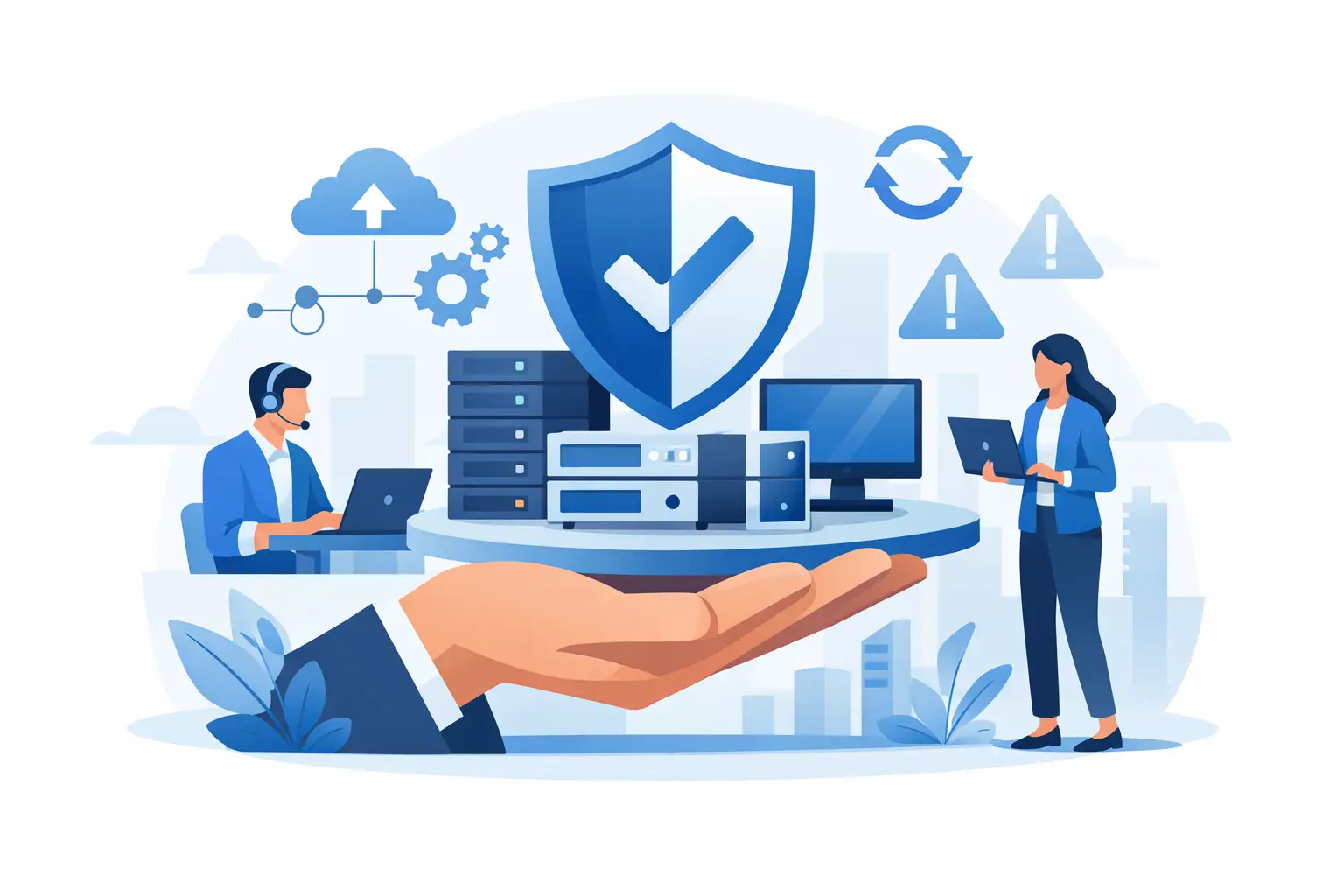
Business continuity IT support is the mix of planning, infrastructure, security controls and day-to-day service needed to keep critical operations available during disruption. It is broader than backup, and it is not the same as disaster recovery alone.
Backup helps you recover data. Disaster recovery helps you restore systems after a major failure. Continuity support sits across both, but also covers the practical steps that reduce the chance of downtime in the first place and limit the effect when something does go wrong. That includes monitoring, patching, endpoint protection, failover planning, access controls, cloud resilience, documented recovery priorities and a support team that can act quickly under pressure.
The key point is simple: continuity is not created by one product. It is built through joined-up decisions about infrastructure, security, support and accountability.
Why many continuity plans fail in practice
On paper, many organisations already have a continuity plan. In reality, those plans often break down because they were written to satisfy a requirement rather than support real operations.
A common issue is that recovery expectations are unrealistic. Leadership may assume systems can be restored in minutes, while the actual backup schedule means data could be several hours old and the restore process could take most of the day. Another problem is fragmented ownership. One supplier manages internet connectivity, another handles Microsoft 365, another looks after cyber security, and no one owns the full recovery path.
There is also the testing gap. If failover has never been tested, if backup restores are not verified, or if key contacts are outdated, then a plan can create false confidence rather than resilience. Businesses usually discover these weaknesses at exactly the wrong time.
The operational cost of getting it wrong
Downtime is expensive, but the real cost is rarely limited to the immediate interruption. Delayed service affects customer confidence. Staff lose productive hours. Sales teams cannot access CRM data. Finance cannot process transactions. If a cyber incident is involved, legal, compliance and insurance obligations add another layer of pressure.
For regulated businesses, the stakes are higher still. A continuity failure can expose gaps in data handling, access management or incident response that create reputational and financial consequences well beyond the original fault. Even for smaller firms, repeated outages quickly become a leadership issue because they point to weak control over core operations.
That is why continuity support should be judged against business outcomes, not technical activity. Faster recovery matters because it protects revenue. Better monitoring matters because it prevents avoidable disruption. Stronger security matters because the easiest outage to manage is the one that never happens.
The foundations of effective business continuity IT support
The strongest continuity models start with prioritisation. Not every system needs the same level of protection, and treating everything as equally critical usually leads to wasted spend. Email may be essential. A line-of-business application may be business-critical. A file archive may be important but less time-sensitive. Your support model should reflect those differences.
That means defining recovery time and recovery point targets in plain business language. How long can this system be unavailable before serious harm is done? How much data can the business afford to lose? Once those answers are clear, the right infrastructure and support controls become easier to design.
Resilience at infrastructure level often includes cloud backup, local redundancy, network resilience, secure remote access, hardware lifecycle planning and protection against single points of failure. At service level, it means proactive monitoring, responsive helpdesk support, documented escalation paths and clear ownership during incidents.
Security also sits at the centre of continuity. Ransomware, credential theft and phishing are continuity threats as much as security threats. If attackers can encrypt systems or lock out users, the business stops. Multi-factor authentication, endpoint detection, patch management and user awareness all support continuity because they reduce the chance of operational disruption.
Business continuity IT support for modern working environments
Hybrid working has changed the continuity picture. Your risk is no longer limited to the office server cupboard or a single internet line at headquarters. Users work across homes, branch locations, mobile devices and cloud platforms. That flexibility is valuable, but it also expands the number of failure points.
A continuity strategy now needs to account for identity management, device compliance, secure connectivity and cloud service dependencies. If staff cannot reach the tools they need from another location, your continuity plan is too narrow. If one person holds the only admin credentials for a business-critical platform, your continuity risk is too high.
The same applies to physical environments such as retail sites, warehouses, front-of-house spaces and data-centre-linked facilities. Connectivity, power, signage systems, access controls and on-site equipment can all affect business continuity. Support works best when those moving parts are managed with a single operational view rather than passed between separate providers.
Choosing the right support model
There is no single blueprint that suits every organisation. A business with one office and twenty staff does not need the same level of resilience engineering as a multi-site operation with compliance demands and customer-facing systems. The right model depends on your tolerance for downtime, regulatory exposure, technical complexity and internal IT capacity.
What should stay consistent is accountability. If continuity support is split across too many vendors, response slows and responsibility becomes blurred. During an incident, you need clear ownership, not a chain of suppliers each waiting on the next.
That is why many businesses move towards a single-partner model for support, security and infrastructure. It simplifies escalation, improves visibility and reduces the operational drag that comes with vendor sprawl. WestTech works in that space because continuity is rarely just a helpdesk issue – it is shaped by how your systems are designed, secured, deployed and supported over time.
What to ask before you invest
If you are reviewing your current position, start with practical questions. Could your team keep working if your main office was unavailable for a day? Do you know which systems must be restored first? Have backups been tested recently? Would your current provider lead the response end to end, or only fix one layer of the problem?
You should also look at hidden weak points. Unsupported hardware, inconsistent patching, poor documentation, over-permissioned accounts and ageing network equipment all increase continuity risk. So do informal workarounds that live in one employee’s head rather than in a documented process.
The best providers will not oversell a one-size-fits-all package. They should be able to explain trade-offs clearly. Higher resilience often means higher cost. Faster recovery may require additional infrastructure. Full geographic redundancy may be excessive for one business and essential for another. Good advice is specific, commercially grounded and realistic about what matters most.
A continuity plan is only as good as its support
Many businesses invest in new platforms, stronger cyber tools and cloud services, then assume continuity will follow automatically. It does not. Technology helps, but continuity depends on whether those tools are configured properly, supported proactively and tied to a clear response plan.
That is why business continuity IT support should be treated as an ongoing operational service, not a one-off project. Risks change. Systems change. Staff change. Your support model needs to keep pace.
If your business cannot afford uncertainty when systems fail, the answer is not more complexity. It is better ownership, better visibility and support that is built around keeping the business running when pressure is highest.