

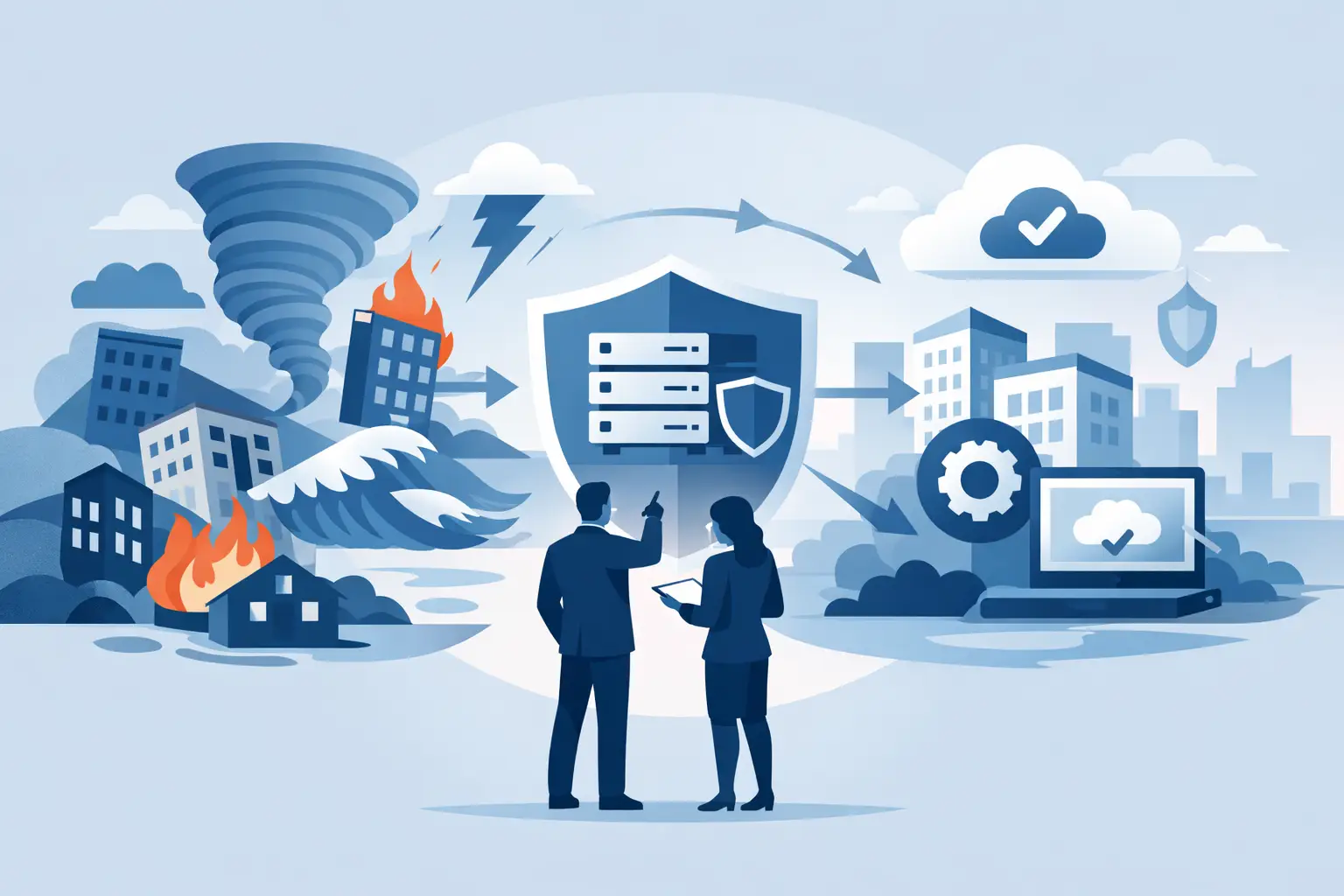
A ransomware alert at 08:17. Phones start ringing by 08:25. By 09:00, staff cannot access files, customers are waiting, and leadership is asking the hardest question in IT – how quickly can we recover? That is where disaster recovery planning for business stops being a document and starts becoming an operational requirement.
For many organisations, the real risk is not just the disruption itself. It is the delay, confusion and cost that follow when no one is clear on priorities, responsibilities or recovery timelines. A good plan reduces downtime, protects revenue, supports compliance and gives your team a practical route back to normal operations.
What disaster recovery planning for business actually means
Disaster recovery planning for business is the process of preparing systems, people and procedures to restore critical operations after a serious incident. That incident might be a cyber attack, server failure, power issue, accidental deletion, cloud outage, fire, flood or site-level disruption.
It sits within the wider business continuity picture, but it has a more technical and operational focus. Business continuity asks how the organisation keeps serving customers. Disaster recovery asks how IT systems, data, connectivity and infrastructure are restored fast enough to make that possible.
That distinction matters. Many businesses assume regular backups are enough. They are not. Backups help, but recovery depends on more than having copies of data. You need to know what must come back first, where it will be restored, who is responsible, how long recovery should take, and what dependencies could slow everything down.
Why businesses struggle when recovery plans are missing
Most organisations do not fail because they ignored risk completely. They fail because they underestimated complexity.
A business may have Microsoft 365 backups, but no documented process for restoring user access at scale. It may have cyber insurance, but not the evidence of controls required to support a claim. It may have failover capacity for one application, but not for the network, telephony or line-of-business systems that staff need to work.
Vendor sprawl makes this worse. When infrastructure, cybersecurity, cloud services and support are split across multiple providers, accountability becomes blurred at exactly the wrong moment. During an incident, every extra handover adds delay. Every unclear ownership point creates more business risk.
The cost is rarely limited to IT. Downtime affects sales, customer service, finance, logistics, compliance reporting and internal confidence. For retail and customer-facing environments, even a short outage can disrupt transactions, digital signage, communications and site operations at the same time.
The core parts of an effective disaster recovery plan
A useful plan is practical, specific and tested. It should not read like a policy written for audit purposes only. It should tell your team what to do under pressure.
The starting point is business impact. Which systems are critical to operations, and what happens if they are unavailable for one hour, four hours or two days? This is where recovery objectives come in. Recovery Time Objective, or RTO, defines how quickly a system must be restored. Recovery Point Objective, or RPO, defines how much data loss is acceptable. Some systems can tolerate delay. Others cannot.
From there, the plan should map dependencies. Your finance platform may rely on identity services, network access, internet connectivity and a specific hosting environment. Your ERP may be useless if printers, warehouse devices or remote access are down. Recovery has to reflect how systems work in real life, not just how they appear on an asset list.
The next element is recovery method. That may involve local backups, immutable backups, cloud replication, virtual failover, alternate hardware, temporary workarounds or third-party service support. The right approach depends on budget, risk profile, compliance needs and the operational importance of each workload.
Clear roles are just as important as technology. Who declares an incident? Who speaks to staff and customers? Who manages the technical response? Who deals with suppliers, insurers and compliance obligations? If those answers are vague, response time will suffer.
Building disaster recovery planning for business around real priorities
The strongest plans are not built around every possible scenario. They are built around what matters most to the business.
For an office-based professional services firm, the priorities may be identity, email, file access, telephony and endpoint security. For a multisite retailer, payment systems, connectivity, signage, stock systems and support coverage may be higher on the list. For a business with data centre infrastructure or specialist applications, the recovery sequence may be more complex and less forgiving.
This is why a generic template often fails. It may tick a box, but it will not reflect your risk exposure, commercial deadlines or technical dependencies. A workable plan should align to operational reality, including out-of-hours support, supplier constraints, user volumes and site-level limitations.
There is also a cost decision to make. Faster recovery usually requires more investment. Real-time replication, standby infrastructure and advanced security controls improve resilience, but they also increase spend. Not every system needs the same level of protection. The aim is to invest where downtime would cause material damage, not to overengineer everything.
Testing is where most plans succeed or fail
A recovery plan that has never been tested is an assumption.
Tabletop exercises are a good start. They help leadership and operational teams walk through decision-making, escalation and communications. But they should not be the end point. Technical recovery tests matter because they expose issues paper-based reviews often miss – missing permissions, outdated contact details, failed backup jobs, incompatible hardware, undocumented changes or restoration times that exceed business expectations.
Testing should cover more than one scenario. Cyber incidents need different handling from hardware failure. Site disruption is different again. In some cases, restoring quickly is the priority. In others, preserving evidence, containing threats or meeting regulatory obligations comes first. It depends on the incident, the sector and the systems involved.
Regular testing also creates confidence. Teams respond better when they have rehearsed the process. Senior stakeholders make decisions faster when they understand the trade-offs before a live incident happens.
Security and recovery need to work together
Disaster recovery is not separate from cybersecurity. The two are closely linked.
A business may have strong backups, but if threat actors can access and encrypt them, recovery becomes far harder. That is why modern recovery planning should include access controls, segmentation, monitoring, immutable or offline backup options, and clear incident response coordination.
There is also a compliance angle. Depending on your sector and data profile, an incident may trigger reporting obligations, contractual commitments or insurer requirements. Recovery decisions can affect all three. Restoring systems without understanding the cause of compromise can create repeat exposure. Waiting too long can extend operational damage. The right approach balances speed with control.
What decision-makers should ask now
If you are responsible for IT performance or operational continuity, the key questions are straightforward.
Do we know which systems must be restored first? Are our backup and recovery targets aligned to business reality? Have we tested recovery properly in the last 12 months? Do our suppliers have clear responsibilities during an incident? Could we maintain customer service if a key platform failed tomorrow morning?
If the answers are uncertain, that is the risk. Most recovery gaps are manageable when identified early. They become expensive when discovered in the middle of a live outage.
This is where a single accountable technology partner can make a significant difference. When infrastructure, support, cybersecurity and implementation sit under one operational model, response is faster and decision-making is clearer. Businesses do not need more moving parts during a crisis. They need ownership, coordination and execution.
WestTech works with businesses that want that clarity – not just more tools, but a joined-up recovery strategy that supports day-to-day operations as well as worst-case scenarios.
Recovery planning is a business decision, not just an IT task
Too many organisations leave disaster recovery to technical teams alone, then expect it to protect the whole business. In practice, the best plans are shaped by operational leaders, finance, compliance stakeholders and senior management alongside IT.
That is because recovery priorities are commercial priorities. What can stop without serious impact, and what cannot? What level of downtime is acceptable, and what level would damage revenue, reputation or customer trust? Those are business decisions first.
The organisations that recover well are rarely the ones with the most complicated documents. They are the ones that prepared with honesty, tested what matters, and made sure responsibility was clear before anything went wrong.
If your current plan lives in a folder and has not been challenged against real business conditions, now is the time to fix that. Recovery works best when it is treated as an operational discipline – planned properly, tested regularly and owned by people who can act when time matters most.